Let's start
What's next
1. Share your requirements
2. Analyze them with our experts
3. Get a detailed pricing
4. Kick off the project
If you have any questions, email us info@nexterse.com

Nexterse will take you through every stage of the software development life cycle (SDLC) – from a business analysis stage through UX/UI and application development to deployment and ongoing support.
Nexterse runs two distinct development lifecycles. The SDLC governs projects where human teams execute structured phases with documented requirements and formal sign-offs at each gate. The Agentic Software Development Lifecycle (ADLC) governs projects where AI agents take active roles in planning, code generation, or testing – with different governance requirements, hallucination controls, and cost-modeling frameworks as a result. The two lifecycles are not interchangeable, and the right one is determined during project scoping.
| Use SDLC when… | Use ADLC when… |
|---|---|
Requirements are defined and can be documented upfront or in a structured Discovery sprint. | AI agents will perform significant parts of planning, code generation, or testing. |
The project requires formal phase approvals – regulated industries, government contracts, enterprise procurement. | Specifications emerge through agent interaction and evolve during the build. |
Delivery teams are human-led with defined roles per phase. | The project's value proposition depends on autonomous agent execution. |
Predictable timelines and cost controls are a primary constraint. | Project output depends on AI agent reasoning, retrieval, or generation – not deterministic rule execution. |
Requirements are defined and can be documented upfront or in a structured Discovery sprint.
The project requires formal phase approvals – regulated industries, government contracts, enterprise procurement.
Delivery teams are human-led with defined roles per phase.
Predictable timelines and cost controls are a primary constraint.
AI agents will perform significant parts of planning, code generation, or testing.
Specifications emerge through agent interaction and evolve during the build.
The project's value proposition depends on autonomous agent execution.
Project output depends on AI agent reasoning, retrieval, or generation – not deterministic rule execution.
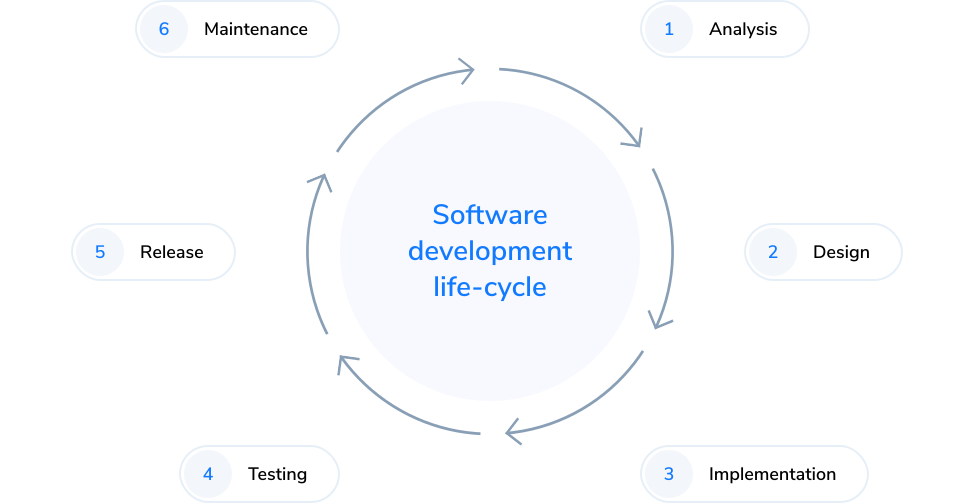
Every Nexterse project moves through six phases in sequence. Each phase has a defined entry point, a set of documented deliverables, and an exit condition that must be met before the next phase begins. The sequence is the same across project sizes – scope and team composition vary, the structure does not.
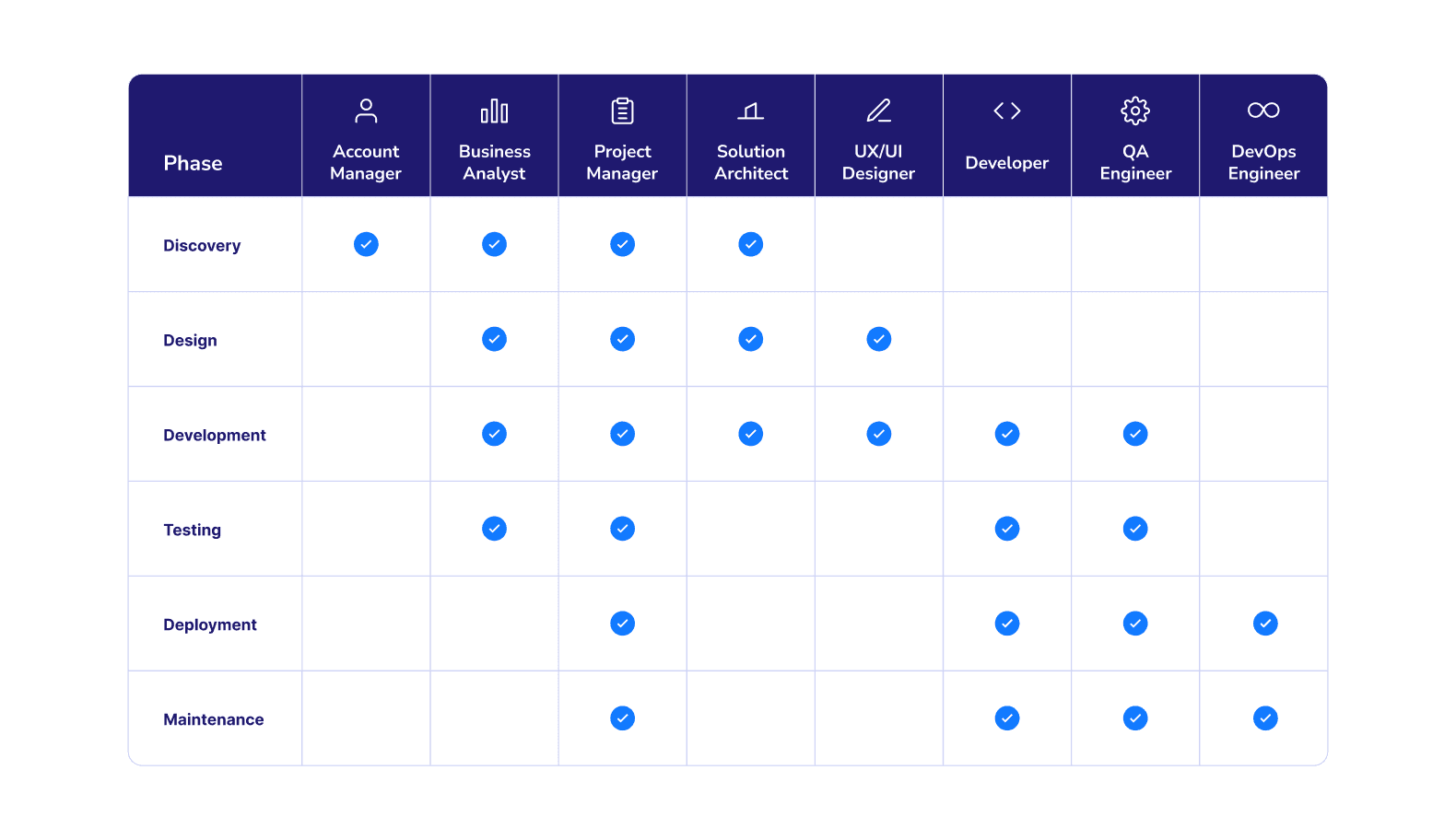
Purpose: Define what gets built, for whom, and under what constraints – before design or development begins. Discovery converts business intent into documented requirements that the full team can build against.
Deliverables:
Team roles active in this phase:
Tools:
Purpose: Translate approved requirements into architecture and interface documentation that development teams can build against without ambiguity.
Deliverables:
Team roles active in this phase:
Tools:
Purpose: Build the approved software in prioritised increments, with continuous integration and structured code review at each step.
Deliverables:
Team roles active in this phase:
Tools:
Purpose: Verify that the delivered software meets the accepted requirements and operates correctly under the conditions defined in the test plan.
Deliverables:
Team roles active in this phase:
Tools:
Purpose: Release the verified build to production under a controlled plan, with a confirmed rollback path and monitored stability.
Deliverables:
Team roles active in this phase:
Tools:
Purpose: Keep the delivered software stable, current, and aligned with evolving business requirements after launch.
Deliverables:
Team roles active in this phase:
Tools:
The project's requirements profile, delivery pace, and Client involvement pattern determine which methodology runs.
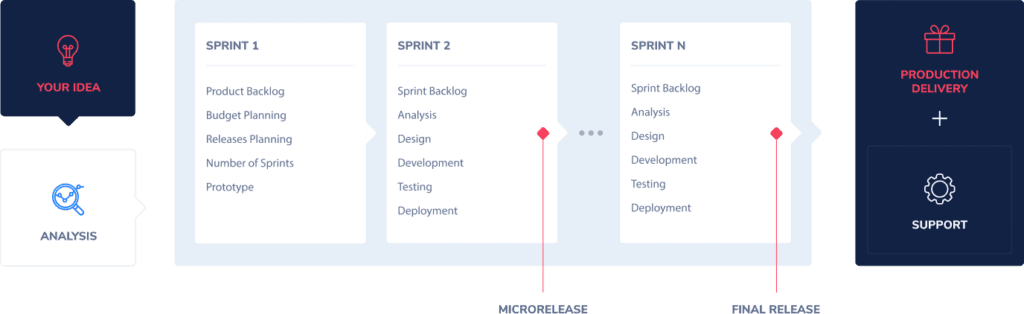
Nexterse uses Scrum when requirements will evolve and the Client wants regular influence over delivery priorities. Work runs in two-week sprints: each sprint opens with a planning session, runs with daily standups, and closes with a review and retrospective where the Client can adjust the backlog for the next cycle. Scrum suits most custom software projects where the full scope is not locked at the outset and Client feedback shapes what gets built next.
The tools below represent Nexterse's typical production stack. Specific selections are adjusted per project based on Client infrastructure, team composition, and technology requirements.
| Category | Tools samples | Role in delivery |
|---|---|---|
| Project management | Jira (or similar like Trello, Notion, etc) | Sprint planning, backlog, bug tracking, release management |
| Documentation | Confluence | Specifications, runbooks, architecture records, decision logs |
| Version control | GitHub / GitLab | Source code repository, pull requests, code review workflow |
| CI/CD | GitLab CI / GitHub Actions | Automated build, test, and deployment pipelines |
| Design | Figma | UI/UX wireframes, interactive prototypes, design system |
| Code quality | SonarQube | Static analysis, security scanning, test coverage tracking |
| Testing | Selenium, Postman, Jest | Functional, API, and unit test automation |
| Cloud | AWS / Azure / GCP | Hosting, managed services, infrastructure provisioning |
Jira (or similar like Trello, Notion, etc)
Confluence
GitHub / GitLab
GitLab CI / GitHub Actions
Figma
SonarQube
Selenium, Postman, Jest
AWS / Azure / GCP
Sprint planning, backlog, bug tracking, release management
Specifications, runbooks, architecture records, decision logs
Source code repository, pull requests, code review workflow
Automated build, test, and deployment pipelines
UI/UX wireframes, interactive prototypes, design system
Static analysis, security scanning, test coverage tracking
Functional, API, and unit test automation
Hosting, managed services, infrastructure provisioning

Nexterse estimates using a three-point model: each task receives an optimistic, most-likely, and pessimistic figure. Requirements are prioritised with MoSCoW to separate scope that must ship from scope that can flex. Estimates are broken down by module and task, with a risk buffer calculated against the project's complexity and integration footprint. The output is an annotated range – not a single number delivered without explanation.

Nexterse structures commercial engagements under four models: Fixed Price for projects with well-defined scope; Time & Material for evolving or exploratory work; Time & Material with a budget cap for Clients who need flexibility within a spend ceiling; and Dedicated Team for Clients who need a fully staffed engineering function running under their direction. The right model is selected during Project Analysis, before the contract is signed.

We partnered with WorkHive to build a modern, responsive web experience focused on usability, performance, and scalability for long-term growth.

We helped Lifty streamline operations through CRM customization and intelligent automation, connecting processes and reducing repetitive work.

We developed a custom software platform tailored to the insurance business, bringing essential processes into one centralized system for teams.

We helped A to Z Travel and Tours strengthen its digital presence with a modern solution that simplifies interactions and showcases travel services.

Running a model agency with a roster of thousands means an enormous amount of profiles, bookings, and digital assets to keep organized, and our internal tools hadn't kept pace with how the industry was moving toward digital modeling. Nexterse LLC built us a platform to manage our models' profiles, availability, and digital assets in one place, and helped us lay the technical groundwork for offering digital twins of our models to brands. What used to be scattered across spreadsheets and inboxes is now a single system our whole team relies on daily, and it's opened doors to work we simply couldn't have taken on before.

Our revenue management platform pulls in pricing and demand data from tens of thousands of properties in near real time, and as we scaled, keeping that data pipeline fast and accurate became a real engineering challenge. Nexterse LLC helped us re-architect parts of our data ingestion layer so it could handle far higher throughput without falling behind during peak booking periods. The platform now processes rate and demand signals faster and more reliably, which directly translates into better pricing recommendations for the properties that depend on us. It's exactly the kind of partner you want when the data never stops coming.

We wanted developers to see code, cloud, and runtime security in one place instead of juggling five different tools, but stitching all those signals together into something fast and genuinely useful was a heavier engineering lift than we expected. Nexterse LLC helped us unify our scanning pipelines so results from different layers of the stack could be correlated and prioritized automatically instead of dumped on developers as noise. Scan times came down, false positives dropped, and our platform now gives teams a single, trustworthy view of their risk instead of another alert queue to ignore.

We made the call to pivot our platform from procurement into HR, which meant rebuilding a meaningful part of the product without disrupting the customers who were already relying on us. Nexterse LLC helped us re-architect the core of the platform so we could introduce entirely new HR workflows while keeping the parts that already worked stable for existing customers. The migration went smoother than we expected for a pivot of that size, and we came out the other side with a cleaner foundation to build the new product on.
Even with a large engineering organization, some internal tooling initiatives don't get the dedicated attention they deserve, and one of our internal reporting dashboards had fallen behind what our own teams actually needed from it. Nexterse LLC came in and rebuilt that internal tool from the ground up, working closely with the teams who used it daily to get the details right. It's a small piece of a much larger platform, but it's the kind of focused, well-executed work that makes a real difference to the people who use it every day.

Our AI headshot platform was growing fast, and our generation pipeline was starting to show it, with turnaround times creeping up whenever demand spiked and quality consistency becoming harder to guarantee at volume. Nexterse LLC rebuilt our image pipeline around a more resilient queuing and processing architecture, so thousands of concurrent headshot jobs no longer competed for the same resources. They also tightened how we handle and discard uploaded photos, which mattered a lot given how sensitive that data is. Turnaround time dropped, output stayed consistent even during our biggest traffic days, and we've been able to scale well past a million headshots delivered without the platform buckling.

As we grew from one AI photography product to a small family of them, our engineering team was stretched thin trying to keep every product's infrastructure reliable at the same time. Nexterse LLC came in as an extension of our engineering team and helped us standardize the infrastructure across our products, so improvements to one no longer meant reinventing the wheel for another. Deploys became safer, incident response got faster, and our small team could finally focus on product instead of firefighting. It's the kind of partner that actually understands what it means to build fast without breaking things.
Nexterse's SDLC runs in six sequential phases: Discovery, Design, Development, Testing, Deployment, and Maintenance. Each phase has documented deliverables, defined team roles, and an explicit exit condition – the next phase does not start until the current one is signed off. The process applies to custom software projects of all sizes, from initial builds to ongoing maintenance contracts.









Let's start