













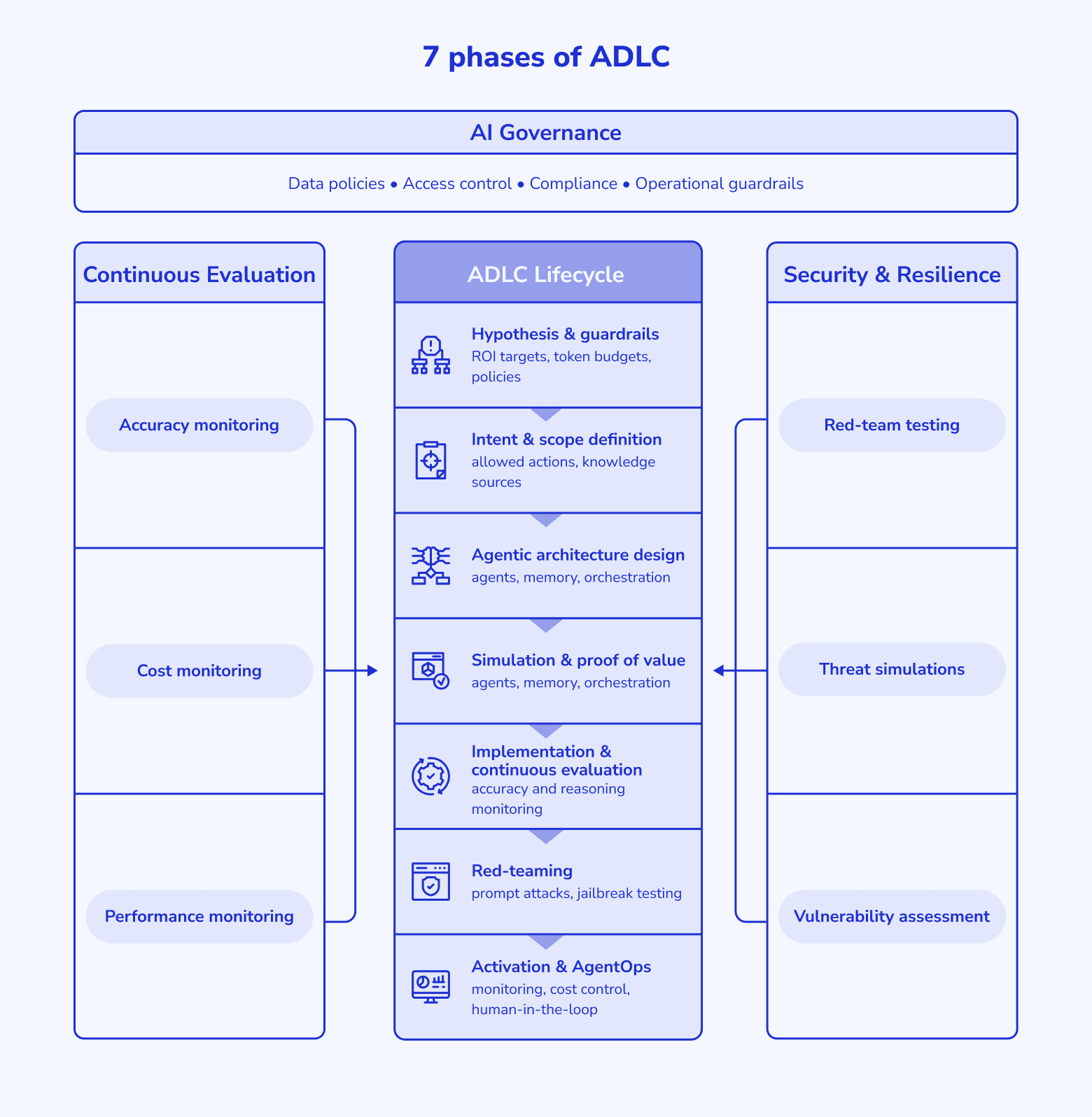
7 phases of Nexterse ADLC
Building AI systems requires more than writing code. Autonomous agents interact with data, make decisions, and execute tasks. Without structured oversight, this can create security, cost, and reliability risks.
Our Agentic Development Lifecycle (ADLC) provides a controlled framework for designing, testing, and deploying AI systems safely and predictably.
Phase 1: Hypothesis & Guardrails
Every AI initiative begins with a clear business hypothesis. We define expected ROI, operational boundaries, and measurable success criteria.
Business benefit: These guardrails ensure the AI system operates within strict cost and security limits from the very beginning.
At this stage we also establish core safety controls:
Phase 1: Hypothesis & Guardrails
Every AI initiative begins with a clear business hypothesis. We define expected ROI, operational boundaries, and measurable success criteria.
Business benefit: These guardrails ensure the AI system operates within strict cost and security limits from the very beginning.
At this stage we also establish core safety controls:
Phase 2: Intent & Scope
Next, we define exactly what the AI system is allowed to do.
This includes mapping knowledge sources, defining allowed actions, and identifying system integrations.
Business benefit: This step prevents uncontrolled agent behavior and ensures the AI operates within a clearly defined mission.
Typical elements include:
Phase 3: Agentic Architecture
Our engineers design the orchestration layer that enables agents to reason, plan, and execute complex workflows.
Business benefit: The goal is to transform a language model into a reliable decision system, not just a chatbot.
The architecture typically includes:
Phase 4: Simulation & Proof of Value
Before deploying an AI system into production, we test it in a controlled sandbox environment.
Business benefit: This step allows organizations to confirm business value before scaling development.
This phase simulates real business scenarios to validate:
Phase 5: Implementation & Continuous Evaluation
Once validated, we implement the AI solution and integrate it with your systems.
Business benefit: These evaluations ensure the system maintains quality as it evolves.
At the same time, we introduce continuous evaluation pipelines that monitor:
Phase 6: Red-Teaming
AI systems must be tested against adversarial scenarios before production deployment.
Business benefit: This process helps identify vulnerabilities and strengthen the system's security posture.
Our teams actively attempt to break or manipulate the system using techniques such as:
Phase 7: Activation & AgentOps
After validation, the AI system is deployed with full operational oversight.
Business benefit: This ensures AI agents remain reliable, transparent, and aligned with business goals over time.
AgentOps infrastructure enables long-term stability through:
Built for security, control, and measurable value

100% data privacy
Your data remains fully under your control.
AI systems can be deployed in private cloud environments, isolated VPCs, or on-premises environments, ensuring sensitive company information never leaves secure boundaries.
- integration testing;
- acceptance testing;
- compatibility testing;
- access control testing.

Proving the ROI first
Before full development begins, the ADLC Simulation & Proof of Value phase evaluates the expected business impact of the AI system.
This includes estimating:
- Token consumption and operational cost.
- Expected performance improvements.
- Measurable operational ROI.
This approach allows organizations to validate value before committing to large-scale implementation.

Human-in-the-loop control
AI systems should assist people, not replace oversight.
We build human-in-the-loop control mechanisms and administrative dashboards that allow teams to monitor AI behavior, approve sensitive actions, and intervene when necessary.
These controls ensure AI systems remain aligned with business policies, regulatory requirements, and operational safety standards.
Nexterse AI ecosystem
Companies adopt AI at different stages of maturity. Some organizations are still exploring where AI could create value, while others are ready to build intelligent products or integrate AI capabilities into existing platforms. We support the full lifecycle of AI adoption from identifying opportunities for AI implementation to governing AI at scale.
Discover & Strategize
For companies exploring AI opportunities but unsure where to begin.
AI consulting
We help organizations identify high-impact AI use cases aligned with real business objectives. Our experts evaluate workflows, data availability, and operational constraints to determine where AI can deliver measurable improvements in efficiency, cost reduction, or new revenue streams.
AI / Gen AI readiness assessment
Before launching AI initiatives, companies must ensure their data infrastructure, security policies, and internal systems can support AI safely.
Our readiness assessment evaluates:
- Data availability and quality.
- System architecture and integrations.
- Security and compliance posture.
- Potential ROI from AI initiatives.
The result is a clear AI adoption roadmap with prioritized opportunities.
Build & Customize
For organizations ready to develop new AI-powered products or internal tools.
AI development
We design and build production-ready AI applications that automate complex workflows, analyze large datasets, and support data-driven decision-making.
Examples include:
- Predictive analytics platforms.
- Intelligent document processing systems.
- AI-driven operational dashboards.
Generative AI development
We create custom generative AI solutions capable of generating text, reports, media, and structured insights based on enterprise data.
Common solutions include:
- AI copilots for employees.
- Automated report generation.
- AI knowledge assistants for internal documentation.
LLM development
For highly specialized domains, we design and train custom language models tailored to specific industry datasets and operational requirements.
LLM fine-tuning
We adapt open-source models such as Llama or Mistral using proprietary company data, improving domain expertise while maintaining full control over sensitive information.
Augment & Integrate
For companies adding AI capabilities to existing software systems.
RAG as a Service
Retrieval-Augmented Generation allows AI systems to securely access internal knowledge bases and company documents without exposing sensitive data to public models.
This enables solutions such as:
- Enterprise knowledge assistants.
- AI support agents for internal teams.
- Automated document search and summarization.
AI integration
We embed predictive intelligence into existing enterprise software, enabling systems to forecast trends, detect anomalies, and recommend decisions.
Generative AI integration
Conversational interfaces, copilots, and AI assistants can be integrated directly into existing products, customer portals, or internal platforms.
Govern & Operate
For organizations running AI systems in production that require reliability, compliance, and cost control.
AI model validation
Independent testing ensures AI models meet accuracy, bias control, and regulatory compliance requirements before production deployment.
LLMOps
Operational infrastructure for managing language models, including prompt management, token cost monitoring, and model routing.
MLOps
CI/CD pipelines and monitoring frameworks that keep machine learning models accurate and scalable as data evolves.
The paradigm shift: why AI requires a new engineering standard
Traditional software and AI systems behave differently. They should not be built the same way.

Traditional software: predictable by design
Web, mobile, and enterprise systems follow fixed logic. If a defined condition occurs, the software performs a defined action. That is why traditional products are built through the Software Development Lifecycle (SDLC) – a proven model focused on planning, development, testing, deployment, and maintenance.
Best suited for:
- Web and mobile platforms.
- Enterprise applications.
- Legacy software systems.
- Internal business software.

AI systems: dynamic by nature
AI agents and large language models do not only execute predefined rules.
They interpret prompts, retrieve information, generate outputs, and make context-based decisions.
That creates new risks:
- Inaccurate responses.
- Unsafe actions.
- Sensitive data exposure.
- Uncontrolled token costs.
To manage these risks, AI systems require a different lifecycle.
Core principles that govern ADLC
We build the Agentic Development Lifecycle on a set of strong engineering principles designed to make AI systems reliable, secure, and economically sustainable in real production environments. These principles ensure that AI agents operate within clear boundaries while maintaining measurable performance and predictable operational costs.

Guardrails for actions and data access
Defines strict operational boundaries for AI agents, controlling what actions they can perform and which data sources they can access.

Continuous evaluation of output quality
AI systems are continuously tested against evaluation datasets to ensure responses remain accurate, consistent, and aligned with business objectives.

Red-team testing against adversarial inputs
AI systems are deliberately stress-tested using adversarial prompts and injection attempts to identify vulnerabilities before deployment.

Monitoring of token usage, cost, and model drift
Operational monitoring tracks token consumption, system performance, and model behavior to maintain predictable operating costs and stable system outputs.

Human oversight for critical decisions
Human-in-the-loop mechanisms ensure that sensitive or high-impact actions always remain under human supervision.
Start your AI journey
Partner with AI experts for reliable, high-quality software.
Our tech partners
Enterprise AI systems require secure infrastructure, reliable model providers, and scalable cloud platforms. Nexterse works with leading cloud and AI technology providers to deliver solutions that meet enterprise standards for security, scalability, and performance.
Cloud infrastructure providers


AI model providers







Case studies that move the numbers

A Modern Web Platform Built for Performance & Growth
We partnered with WorkHive to build a modern, responsive web experience focused on usability, performance, and scalability for long-term growth.

Transforming Business Operations with CRM & Automation
We helped Lifty streamline operations through CRM customization and intelligent automation, connecting processes and reducing repetitive work.

Building a Custom Software Platform for Insurance Operations
We developed a custom software platform tailored to the insurance business, bringing essential processes into one centralized system for teams.

Building a Smarter Digital Experience for Travel & Tourism
We helped A to Z Travel and Tours strengthen its digital presence with a modern solution that simplifies interactions and showcases travel services.

Our AI headshot platform was growing fast, and our generation pipeline was starting to show it, with turnaround times creeping up whenever demand spiked and quality consistency becoming harder to guarantee at volume. Nexterse LLC rebuilt our image pipeline around a more resilient queuing and processing architecture, so thousands of concurrent headshot jobs no longer competed for the same resources. They also tightened how we handle and discard uploaded photos, which mattered a lot given how sensitive that data is. Turnaround time dropped, output stayed consistent even during our biggest traffic days, and we've been able to scale well past a million headshots delivered without the platform buckling.

As we grew from one AI photography product to a small family of them, our engineering team was stretched thin trying to keep every product's infrastructure reliable at the same time. Nexterse LLC came in as an extension of our engineering team and helped us standardize the infrastructure across our products, so improvements to one no longer meant reinventing the wheel for another. Deploys became safer, incident response got faster, and our small team could finally focus on product instead of firefighting. It's the kind of partner that actually understands what it means to build fast without breaking things.

Our skills intelligence platform runs on a stack of proprietary language models, and as enterprise customers scaled up their usage, keeping inference fast and accurate across every model became a serious infrastructure challenge. Nexterse LLC helped us optimize how our models are served and monitored in production, cutting inference latency significantly while keeping accuracy where our enterprise customers need it. That work gave us the headroom to keep growing without our infrastructure becoming the bottleneck, and it's held up well through some of our fastest growth to date.

We set out to build a QA platform that could learn how real users move through a product and keep testing those flows on its own, but getting that kind of autonomous testing to be reliable enough for teams to actually trust was the hard part. Nexterse LLC worked with us on the engine that captures and replays user flows, helping us cut down on flaky test runs and false failures that would have killed trust in the product early on. The platform now catches real regressions before they reach users, consistently, which is the entire point of what we set out to build.

Our research produces genuinely more efficient language models, but turning that research into a product that customers could actually integrate and rely on was a different kind of problem than the one we're used to solving. Nexterse LLC helped us build the serving and integration layer around our models, so customers get a stable API and predictable performance instead of having to understand the research underneath it. That layer has made it far easier for us to get our efficiency gains in front of customers without asking them to compromise on reliability.

Running a model agency with a roster of thousands means an enormous amount of profiles, bookings, and digital assets to keep organized, and our internal tools hadn't kept pace with how the industry was moving toward digital modeling. Nexterse LLC built us a platform to manage our models' profiles, availability, and digital assets in one place, and helped us lay the technical groundwork for offering digital twins of our models to brands. What used to be scattered across spreadsheets and inboxes is now a single system our whole team relies on daily, and it's opened doors to work we simply couldn't have taken on before.

Our revenue management platform pulls in pricing and demand data from tens of thousands of properties in near real time, and as we scaled, keeping that data pipeline fast and accurate became a real engineering challenge. Nexterse LLC helped us re-architect parts of our data ingestion layer so it could handle far higher throughput without falling behind during peak booking periods. The platform now processes rate and demand signals faster and more reliably, which directly translates into better pricing recommendations for the properties that depend on us. It's exactly the kind of partner you want when the data never stops coming.
Awards & Recognitions




Let's start