















Our LLM engineering services
Most of the model development work sits in data preparation, system design, deployment planning, and evaluation. Nexterse LLC builds the full LLM delivery path, from ingestion pipelines and model adaptation to inference optimization and production rollout in your cloud or internal environment.

Data curation and pipeline engineering
Model quality depends on data quality. We build the pipelines that ingest, filter, de-duplicate, structure, chunk, and tokenize enterprise data before it reaches the model. This includes work with documents, internal records, product knowledge, support content, and domain-specific text corpora.
The goal is to make the training or retrieval layer robust: when the input data is inconsistent, outdated, or poorly structured, the model output remains consistent. We reduce that risk upstream.

Model fine-tuning with PEFT and LoRA
When prompt design and retrieval are not enough, we fine-tune open-source models for narrower tasks and stronger domain fit. We use parameter-efficient methods such as LoRA to adapt the model to your vocabulary, response format, reasoning patterns, and content rules without the cost of full-scale retraining.
This approach works well when you need a model to write in a defined format, classify domain content, extract structured information, or support internal workflows where consistency matters more than general-purpose breadth.

Custom model training
Some companies need more than adaptation. When the business case supports it, we design and train proprietary models on large internal datasets with full control over the architecture, training process, and deployment path.
This work includes training strategy, experiment design, hyperparameter tuning, distributed training orchestration, evaluation pipelines, and production preparation. We recommend this route only when the data volume and expected return justify the cost.

Inference optimization and quantization
A model has to be affordable to run after it’s built. We optimize inference so the system can operate with lower latency, lower infrastructure spend, and tighter deployment constraints. That includes quantization, model compression, serving optimization, and runtime tuning across cloud, on-premises, and edge environments.
This is often what makes an LLM system viable beyond the pilot stage. A model that performs well in testing still has to meet cost, speed, and infrastructure requirements in production.
Build vs. Buy vs. Adapt
The goal is to solve your business problem with the right level of engineering.
Tier 1. Enterprise RAG
You do not need a new model if the main issue is access to internal knowledge. In this setup, we connect your documents, records, and source systems to a secure model through retrieval pipelines, vector search, and permissions-aware access controls.
- Best fit for: Internal search, document Q&A, policy lookup, support knowledge tools.
- What you get: Faster time to value, lower model risk, and stronger grounding in enterprise data.
Book your free discovery call
Discuss your business challenge with our LLM development experts and find out exactly how we can solve it.
Our recent AI cases

A Modern Web Platform Built for Performance & Growth
We partnered with WorkHive to build a modern, responsive web experience focused on usability, performance, and scalability for long-term growth.

Transforming Business Operations with CRM & Automation
We helped Lifty streamline operations through CRM customization and intelligent automation, connecting processes and reducing repetitive work.

Building a Custom Software Platform for Insurance Operations
We developed a custom software platform tailored to the insurance business, bringing essential processes into one centralized system for teams.

Building a Smarter Digital Experience for Travel & Tourism
We helped A to Z Travel and Tours strengthen its digital presence with a modern solution that simplifies interactions and showcases travel services.

Our AI headshot platform was growing fast, and our generation pipeline was starting to show it, with turnaround times creeping up whenever demand spiked and quality consistency becoming harder to guarantee at volume. Nexterse LLC rebuilt our image pipeline around a more resilient queuing and processing architecture, so thousands of concurrent headshot jobs no longer competed for the same resources. They also tightened how we handle and discard uploaded photos, which mattered a lot given how sensitive that data is. Turnaround time dropped, output stayed consistent even during our biggest traffic days, and we've been able to scale well past a million headshots delivered without the platform buckling.

As we grew from one AI photography product to a small family of them, our engineering team was stretched thin trying to keep every product's infrastructure reliable at the same time. Nexterse LLC came in as an extension of our engineering team and helped us standardize the infrastructure across our products, so improvements to one no longer meant reinventing the wheel for another. Deploys became safer, incident response got faster, and our small team could finally focus on product instead of firefighting. It's the kind of partner that actually understands what it means to build fast without breaking things.

Our skills intelligence platform runs on a stack of proprietary language models, and as enterprise customers scaled up their usage, keeping inference fast and accurate across every model became a serious infrastructure challenge. Nexterse LLC helped us optimize how our models are served and monitored in production, cutting inference latency significantly while keeping accuracy where our enterprise customers need it. That work gave us the headroom to keep growing without our infrastructure becoming the bottleneck, and it's held up well through some of our fastest growth to date.

We set out to build a QA platform that could learn how real users move through a product and keep testing those flows on its own, but getting that kind of autonomous testing to be reliable enough for teams to actually trust was the hard part. Nexterse LLC worked with us on the engine that captures and replays user flows, helping us cut down on flaky test runs and false failures that would have killed trust in the product early on. The platform now catches real regressions before they reach users, consistently, which is the entire point of what we set out to build.

Our research produces genuinely more efficient language models, but turning that research into a product that customers could actually integrate and rely on was a different kind of problem than the one we're used to solving. Nexterse LLC helped us build the serving and integration layer around our models, so customers get a stable API and predictable performance instead of having to understand the research underneath it. That layer has made it far easier for us to get our efficiency gains in front of customers without asking them to compromise on reliability.

Running a model agency with a roster of thousands means an enormous amount of profiles, bookings, and digital assets to keep organized, and our internal tools hadn't kept pace with how the industry was moving toward digital modeling. Nexterse LLC built us a platform to manage our models' profiles, availability, and digital assets in one place, and helped us lay the technical groundwork for offering digital twins of our models to brands. What used to be scattered across spreadsheets and inboxes is now a single system our whole team relies on daily, and it's opened doors to work we simply couldn't have taken on before.

Our revenue management platform pulls in pricing and demand data from tens of thousands of properties in near real time, and as we scaled, keeping that data pipeline fast and accurate became a real engineering challenge. Nexterse LLC helped us re-architect parts of our data ingestion layer so it could handle far higher throughput without falling behind during peak booking periods. The platform now processes rate and demand signals faster and more reliably, which directly translates into better pricing recommendations for the properties that depend on us. It's exactly the kind of partner you want when the data never stops coming.
Total cost of ownership (TCO)
External model APIs are easy to start with, but usage-based pricing can become expensive at scale. A hosted custom model can lower long-term inference cost when the workload is steady enough.
What we compare during scoping or pilot work
- API path: Token-based usage costs, vendor dependence, scaling curve, and integration overhead.
- Hosted model path: Infrastructure cost, serving setup, maintenance effort, and expected unit economics over time.
What you get
A side-by-side cost view tied to your projected usage, deployment model, and operating constraints.
Why companies choose Nexterse LLC for LLM development
Deep engineering coverage
We build the system end-to-end. That includes the data and model layers, the serving setup, and the surrounding software.

Architecture matched to the use case
We start with the business problem, then choose the lightest architecture that can do the job well. Sometimes that means RAG. Sometimes it means targeted model adaptation. We move to a heavier build only when the case supports it.

Integration built into delivery
We treat integration as core engineering work. Our team designs LLM systems to work with older enterprise systems and newer business applications.

Deployment shaped around constraints
We deploy in private cloud, on internal infrastructure, or in local environments when the use case calls for it. The choice depends on data-handling rules, response targets, hardware limitations, and long-term costs.

Awards& Recognitions
Leading analyst agencies that track the best LLM and AI development companies worldwide have recognized Nexterse LLC. Our values and our partners help us deliver services at that level.

Prototype your AI product
From “napkin sketch” to MVP. Our rapid development sprints help you launch an LLM-powered feature in weeks, not months.
Dual-engine integration
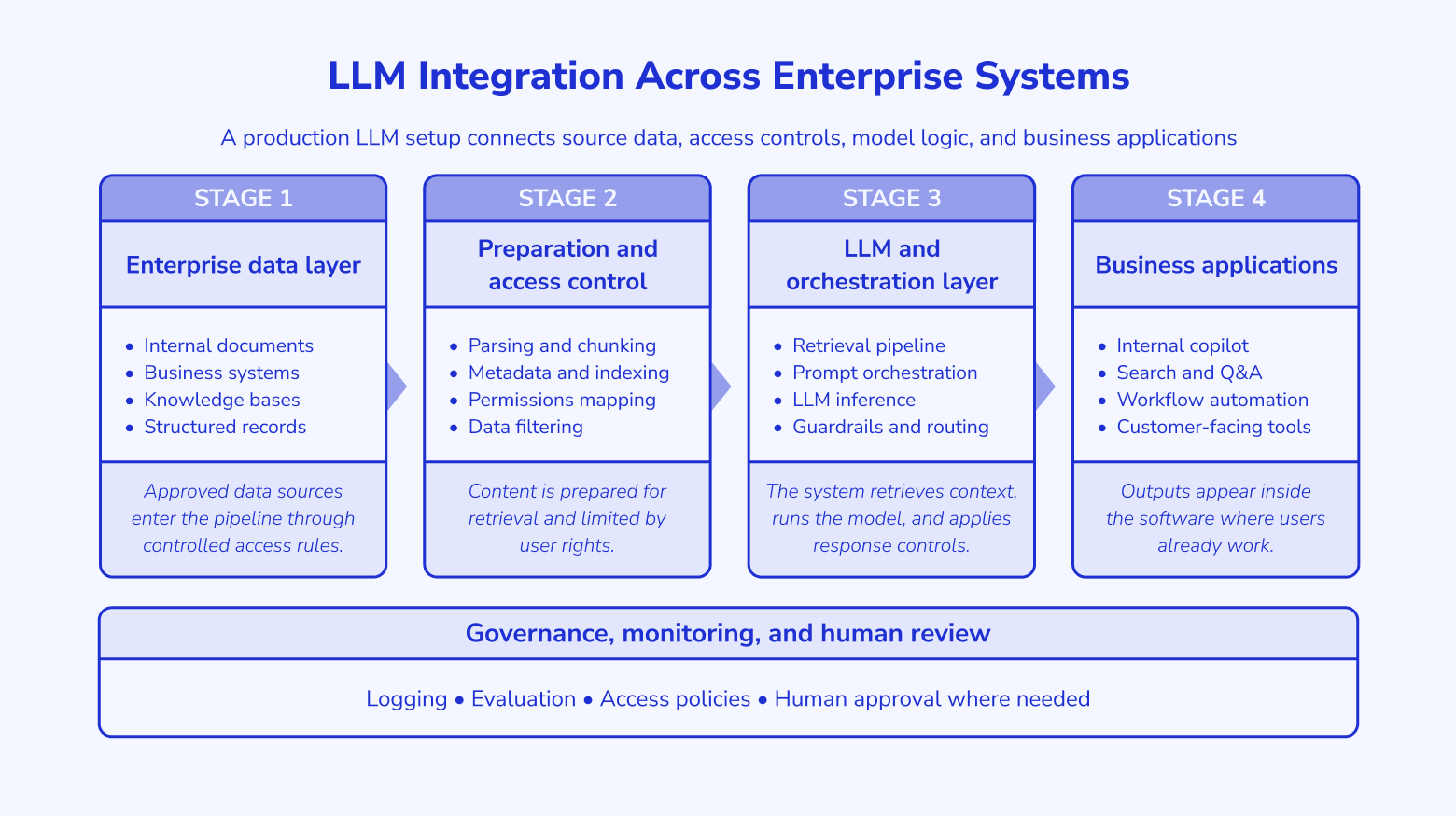
A strong model must connect to the systems your teams already use to deliver outputs within real workflows, while respecting permissions.
Integration into modern software
We connect LLM functionality to web platforms, SaaS products, customer portals, internal dashboards, and workflow tools. That includes API integration, retrieval layers, user-facing interfaces, and orchestration logic that moves model outputs to the appropriate step in the process.
For companies building AI-enabled features into existing products, this is often the fastest route from prototype to live use.
Flexible deployment
We base deployment decisions on data sensitivity, latency targets, hardware limits, and long-term operating cost.
Private cloud deployment
We deploy the model inside your private cloud environment (AWS, Azure, or Google Cloud) and align it with your internal security model. The setup includes isolated infrastructure, role-based access controls, monitoring, and the service layer that connects the model to your systems.
Best fit for: Companies that need stronger control over data handling and runtime setup without moving the full workload onto internal servers.
Technology stack


























Who builds the system
LLM delivery takes data engineering, infrastructure design, software integration, and production oversight. For this, our engineering team employs:

Data architects
They build the data pipelines behind the system. This role handles ingestion, deduplication, data shaping, storage design, and retrieval architecture to ensure the model operates on reliable inputs.

NLP and ML engineers
They own model selection, fine-tuning setup, evaluation logic, and training workflows. This role adapts the model to your domain and measures its performance on the task.

LLMOps specialists
They build the deployment pipeline and production controls. This role manages model serving, monitoring, rollback planning, runtime health, and ongoing model updates.

Software engineers
They connect the model to the business application. This role builds APIs, middleware, user-facing interfaces, and workflow logic to enable the LLM to operate within real systems.
Our ADLC process
We use the Agentic Development Lifecycle to move from business needs to production in controlled stages. AI helps us speed up analysis, draft parts of the solution, generate code scaffolds, and expand test coverage. Our engineers review, edit, and validate that work before it moves forward.
Define the use case
We map the business task, target users, success criteria, and operating constraints. AI may help summarize source materials or group requirements, but our team sets the final scope and delivery plan.
Review data and systems
We assess source data, access rules, software dependencies, and deployment limits. AI can help process large volumes of content and surface patterns. Our engineers verify the findings and choose the right path for the project.
Design and build the system
We design the architecture, then build the data pipelines, model layer, serving setup, and integrations. AI may assist with code drafts, documentation drafts, and test generation. Developers revise that output and harden it for production use.
Validate in a controlled environment
We test output quality, failure handling, latency, cost, and workflow fit. AI can help generate edge cases and test scenarios. Our team reviews the results, tunes the system, and adds human review steps where risk warrants them.
Deploy and improve
We deploy with monitoring, versioning, access control, and update workflows. After launch, we track system behavior, review output quality, and refine the solution as requirements change.
Frequently asked questions
Ownership terms depend on the engagement model, but for custom LLM work, the client typically receives full rights to the delivered solution. That can include model artifacts, pipeline logic, deployment setup, and the project’s integration layer.
Let's start