














CRM development services
CRM development is not a single activity. It is a sequence of structured decisions about your sales process, data model, integrations, and rollout. We deliver CRM as a set of clearly defined services, so you can engage exactly where your revenue operations need progress — with full visibility into scope, effort, and outcomes.
CRM consulting & requirements discovery
We establish a precise understanding of how your teams sell, market, and support customers today. We map your pipeline stages, data sources, integrations, and reporting needs, and identify where manual work, data gaps, and low adoption hurt revenue. Requirements are captured in a shared, prioritized view.
Result:
A clear process map, a target CRM data model, and a phased plan with explicit trade-offs — allowing decisions to be made with confidence and alignment across sales, marketing, and support.
Custom CRM development
We build CRM platforms tailored to your pipeline, roles, and workflows — contact and account management, deal stages, quoting, activity tracking, automation rules, and dashboards. The interface is designed for speed and adoption, so reps capture data as a byproduct of their work rather than extra overhead.
Result:
A CRM your team actually uses, with clean pipeline data, automated follow-ups, and reporting that reflects reality.
CRM integration & data migration
We connect the CRM to email, calendar, ERP, marketing automation, support desks, telephony, and billing, and migrate your existing records without losing history. Data is deduplicated, validated, and synchronized across systems through a resilient integration layer with logging and retries.
Result:
A single source of truth for customer data, synchronized systems, and a clean migration with pipeline continuity preserved.
AI-accelerated CRM
We add AI where it creates measurable value — lead and deal scoring, next-best-action, churn and deal-risk flags, conversation summaries, and automated data entry. AI connects to a governed data layer with role-based access, and outputs are presented as assistive suggestions your team can review before acting.
Result:
Reps focus on high-intent accounts, less time is lost to manual entry, and AI insights operate on clean, governed customer data.
Get your CRM roadmap
Receive a phased, low-risk plan to build or replace your CRM without disrupting sales operations.
Business outcomes after CRM development
A CRM matters when it improves pipeline predictability, drives adoption, and makes revenue easier to forecast and control. The outcomes below describe what changes once your CRM stops creating manual work and starts driving reliable decisions.
Predictable pipeline and forecasting
We structure your CRM around a clearly defined sales process, so every deal, stage, and activity is captured consistently. Pipeline data becomes reliable, forecasts reflect reality, and managers can see where revenue is progressing or stalling. With clean stage logic and automated activity tracking, reporting stops depending on manual spreadsheets and starts driving confident decisions.
Predictable pipeline and forecasting
Higher adoption and less manual work
Reduced revenue leakage and operational risk
Stronger security and compliance control
Reliable customer data for revenue decisions
Capacity for growth with an AI-ready CRM
Your CRM blocks revenue growth
The CRM keeps running, but how it is structured defines how far your revenue operations can go. Automation, analytics, and AI require clean data and flexible workflows. In a poorly-fit or off-the-shelf CRM stretched beyond its design, that flexibility is limited.

Low user adoption
Reps avoid a CRM that adds clicks and duplicate data entry. When the system is not used consistently, the pipeline is incomplete, forecasts drift, and managers lose trust in the numbers.

Manual data entry
Emails, calls, and meetings are logged by hand — or not at all. Time that should go to selling is lost to admin work, and the activity data that drives insight stays incomplete.

Rigid workflows
The CRM was configured for how you worked years ago. Changing a stage, field, or automation turns into a project, so processes bend around the tool instead of the tool serving the process.

Fragmented customer data
Contacts and history are spread across the CRM, spreadsheets, inboxes, and marketing tools with duplicates and inconsistent ownership. No one sees the full customer picture in one place.

Security and compliance
Access rules, data retention, and consent handling reflect earlier requirements. As privacy standards evolve, keeping customer PII protected and auditable becomes increasingly complex.

AI initiatives constrained
Lead scoring, copilots, and next-best-action need stable APIs, consistent data, and governed access. A CRM with messy data and no integration layer cannot support these capabilities reliably.
Request a CRM audit
Identify adoption gaps, data quality issues, and automation opportunities in your current CRM.
CRM platforms we build
We build and customize CRM platforms that support real revenue operations, carry your customer data, and connect sales, marketing, and support — while preparing them for AI integration and data-driven workflows.
- Custom sales CRM with pipeline, deals, and quoting
- B2B and B2C contact and account management platforms
- Marketing automation and lead-nurturing workflows
- Customer service and support-desk CRM modules
- Integrations with email, ERP, billing, telephony, and marketing tools
- Customer data platforms, reporting pipelines, and analytics prepared for AI use
- AI integration layer, including APIs, data pipelines, and lead-scoring models
If a system holds your customer relationships, drives your pipeline, or connects multiple revenue teams, we build it with a structure that keeps operations stable and enables controlled, scalable growth — with AI capabilities embedded where they create measurable value.

Custom CRM software we developed

A Modern Web Platform Built for Performance & Growth
We partnered with WorkHive to build a modern, responsive web experience focused on usability, performance, and scalability for long-term growth.

Transforming Business Operations with CRM & Automation
We helped Lifty streamline operations through CRM customization and intelligent automation, connecting processes and reducing repetitive work.

Building a Custom Software Platform for Insurance Operations
We developed a custom software platform tailored to the insurance business, bringing essential processes into one centralized system for teams.

Building a Smarter Digital Experience for Travel & Tourism
We helped A to Z Travel and Tours strengthen its digital presence with a modern solution that simplifies interactions and showcases travel services.

Running a model agency with a roster of thousands means an enormous amount of profiles, bookings, and digital assets to keep organized, and our internal tools hadn't kept pace with how the industry was moving toward digital modeling. Nexterse LLC built us a platform to manage our models' profiles, availability, and digital assets in one place, and helped us lay the technical groundwork for offering digital twins of our models to brands. What used to be scattered across spreadsheets and inboxes is now a single system our whole team relies on daily, and it's opened doors to work we simply couldn't have taken on before.

Our revenue management platform pulls in pricing and demand data from tens of thousands of properties in near real time, and as we scaled, keeping that data pipeline fast and accurate became a real engineering challenge. Nexterse LLC helped us re-architect parts of our data ingestion layer so it could handle far higher throughput without falling behind during peak booking periods. The platform now processes rate and demand signals faster and more reliably, which directly translates into better pricing recommendations for the properties that depend on us. It's exactly the kind of partner you want when the data never stops coming.

We wanted developers to see code, cloud, and runtime security in one place instead of juggling five different tools, but stitching all those signals together into something fast and genuinely useful was a heavier engineering lift than we expected. Nexterse LLC helped us unify our scanning pipelines so results from different layers of the stack could be correlated and prioritized automatically instead of dumped on developers as noise. Scan times came down, false positives dropped, and our platform now gives teams a single, trustworthy view of their risk instead of another alert queue to ignore.

We made the call to pivot our platform from procurement into HR, which meant rebuilding a meaningful part of the product without disrupting the customers who were already relying on us. Nexterse LLC helped us re-architect the core of the platform so we could introduce entirely new HR workflows while keeping the parts that already worked stable for existing customers. The migration went smoother than we expected for a pivot of that size, and we came out the other side with a cleaner foundation to build the new product on.

Even with a large engineering organization, some internal tooling initiatives don't get the dedicated attention they deserve, and one of our internal reporting dashboards had fallen behind what our own teams actually needed from it. Nexterse LLC came in and rebuilt that internal tool from the ground up, working closely with the teams who used it daily to get the details right. It's a small piece of a much larger platform, but it's the kind of focused, well-executed work that makes a real difference to the people who use it every day.

Our AI headshot platform was growing fast, and our generation pipeline was starting to show it, with turnaround times creeping up whenever demand spiked and quality consistency becoming harder to guarantee at volume. Nexterse LLC rebuilt our image pipeline around a more resilient queuing and processing architecture, so thousands of concurrent headshot jobs no longer competed for the same resources. They also tightened how we handle and discard uploaded photos, which mattered a lot given how sensitive that data is. Turnaround time dropped, output stayed consistent even during our biggest traffic days, and we've been able to scale well past a million headshots delivered without the platform buckling.
We speak both languages: CRM systems and LLMs
As a dual-engine engineering firm, we build reliable, structured CRM platforms while introducing governed AI capabilities as a native part of the system. This allows your CRM to remain stable in daily use while becoming ready for modern AI-driven revenue workflows.

Customer data unification and enrichment
We turn scattered customer data into a structured, usable asset. We design ETL pipelines that extract, clean, deduplicate, and standardize records across your CRM, spreadsheets, marketing tools, and support systems, then enrich and structure them for retrieval and analysis. Customer history is no longer locked in isolated silos — it becomes a single, searchable source of truth usable across applications and AI layers, supporting reporting, automation, and AI-driven interaction without extra operational complexity.

AI-accelerated CRM workflows
We add AI to the CRM with controlled engineering workflows. We use governed AI tooling for lead and deal scoring, next-best-action, deal-risk detection, conversation summaries, and automated data capture from emails and calls. Outputs are presented as assistive suggestions your team can review, so the CRM works faster while decisions stay with people. The result is less manual work, sharper prioritization, and insights grounded in your real customer data.

Incremental CRM rollout with operational continuity
We deliver CRM in controlled steps, without disrupting how your teams sell and support customers. We avoid a risky all-at-once launch. Instead, we roll out modules and teams progressively, introduce modern interfaces, and evolve the platform in stages. Each step integrates with your existing tools while preparing for future capabilities. This keeps pipeline operations stable while steadily improving CRM structure, adoption, and performance.

Security and access control as part of the CRM
We embed modern security standards directly into the CRM design. We implement role-based and field-level access control, secure API mediation, and modern authentication mechanisms such as OAuth 2.0. Customer data handling and system interaction follow clearly defined rules, ensuring that access, usage, and integrations remain consistent and auditable. This creates a CRM that aligns with current privacy and compliance expectations while remaining adaptable to future requirements.
Request a CRM development quote
Identify hidden opportunities, risks, and planning gaps in your current CRM solution.
Riskcontrol & engineering discipline
CRM development is executed as a controlled engineering process with clearly defined system behavior at every stage. Each change is introduced through structured release mechanics, validated against real workloads, and aligned with production constraints. The result is a predictable rollout with stable, observable CRM performance.
No-downtime execution as a standard approach
Changes are introduced through phased releases, parallel environments, and controlled traffic routing. Components are updated incrementally, allowing new and existing logic to operate side by side while behavior is continuously observed and validated.
Data integrity built into every step
Data handling follows a defined validation flow. Schemas, dependencies, and records are verified before and after each transformation. Migration steps are repeatable, traceable, and aligned with production data structures, ensuring consistency across systems.
Validation under real operating conditions
System changes are tested against realistic data volumes, integrations, and performance scenarios. Business logic, edge cases, and system behavior are evaluated before release, ensuring alignment with production conditions.
Controlled coexistence of system components
Existing and newly built CRM modules operate within clearly defined boundaries. Interfaces are explicit, responsibilities are separated, and interactions are observable. This structure allows individual modules to evolve independently while maintaining overall CRM coherence.
Governed AI integration layer
AI capabilities are introduced as controlled system components within the architecture. Model access is mediated through APIs and middleware, with defined input and output boundaries, rate control, and usage policies. Data used for AI processing follows structured pipelines, including transformation, validation, and access control.
Rollback and recovery as engineered capabilities
Each release includes predefined rollback paths and recovery procedures. These are validated before deployment and aligned with system dependencies, ensuring that system state remains consistent and controlled throughout the transition.
Cost of the wrong CRM in an AI-driven environment
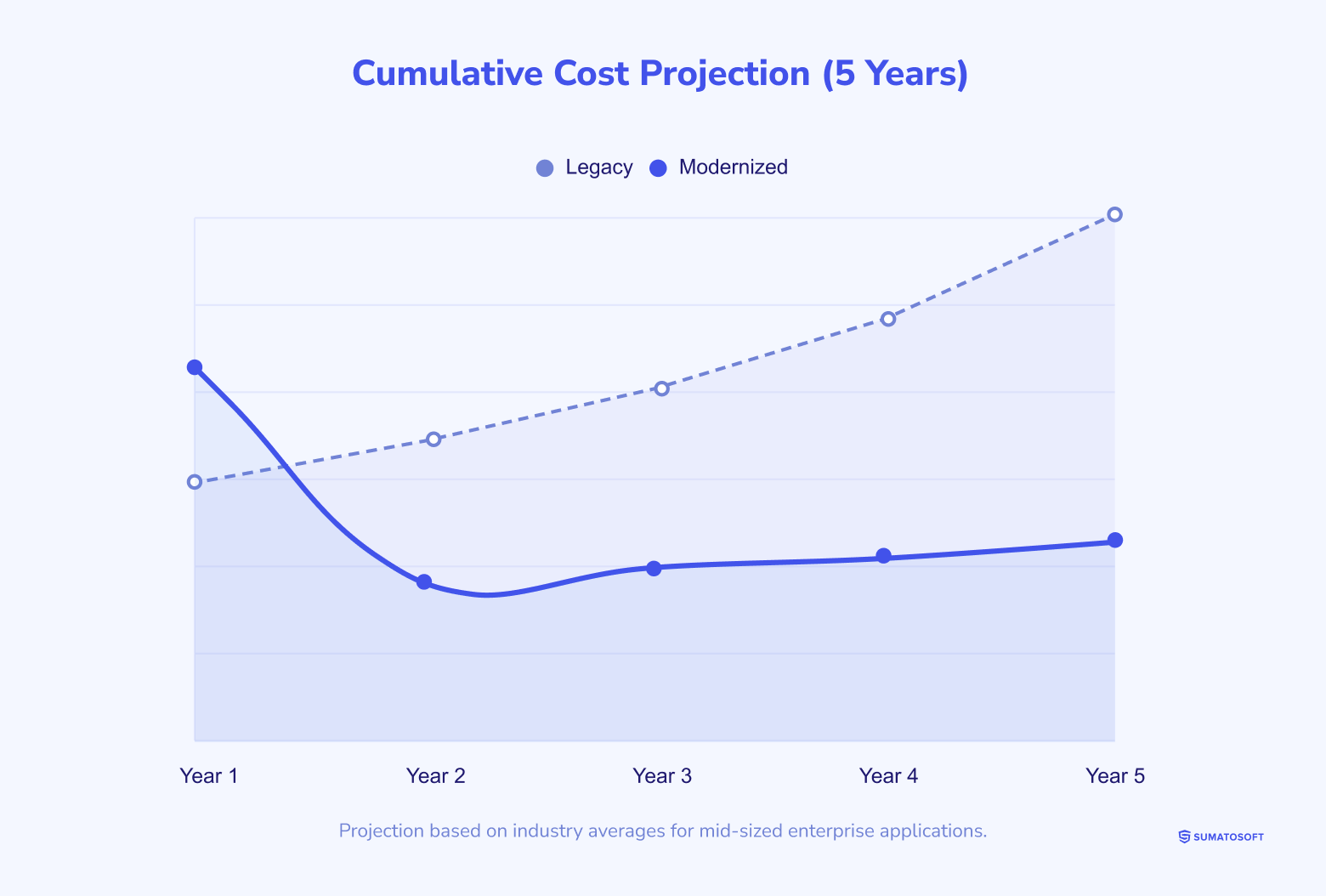
AI depends on structured data, clear interfaces, and adaptable systems. In a poorly-fit CRM, adding lead scoring, copilots, or automation requires additional preparation — cleaning data, aligning fields, defining APIs, and untangling integrations across tools.
At the same time, low adoption and manual data entry keep absorbing your team's capacity. Reps split effort between selling and feeding a system that gives little back, which extends cycles and quietly increases the total cost of ownership through licensing, workarounds, and lost deals.
A well-built CRM operates differently. With a clean data model and accessible customer data, automation and AI capabilities are introduced with predictable effort, and costs stabilize as the platform becomes easier to evolve.
Phased CRM rollout approach
We deliver CRM through controlled, incremental rollout. Instead of forcing your teams onto an entire new platform overnight, we roll it out step by step — introducing modules, integrations, and AI capabilities where they deliver immediate value.
Incremental rollout with operational continuity
We start with a single workflow or team and deliver it as a working slice of the CRM. This new capability operates alongside your current tools, handling a defined scope without disrupting surrounding processes. Each step is self-contained, observable, and validated with real users before moving further. The CRM grows in place, while your pipeline keeps running.
Structured modeling of your sales process
Sales, marketing, and support processes are often implicit and spread across tools. We model this logic into clearly defined CRM stages, roles, and automation rules with explicit ownership.
This creates:
- Consistent pipeline stages and definitions
- Predictable behavior as processes change
- Clear data ownership across teams
Over time, the business shifts from scattered spreadsheets to a single, governed customer record.
AI integration at the right data layer
AI capabilities are introduced only after the CRM has clean, governed data to support them. We connect lead scoring, copilots, and automation to structured data pipelines and API layers — never to messy, ungoverned records directly. This enables consistent interaction with customer data, reliable performance, and controlled integration with existing workflows. AI becomes a managed part of the CRM, not an external add-on.
Controlled evolution toward a unified CRM
As individual modules go live, reliance on spreadsheets and disconnected tools gradually narrows. The CRM takes on more responsibility, while ad-hoc workarounds are phased out naturally. This approach results in steady improvement, higher adoption, and a platform that becomes easier to extend, integrate, and scale over time.
Zero-disruption CRM migration pipeline
CRM delivery progresses through a structured pipeline designed for continuous sales operation, controlled change, and measurable advancement. Each phase builds on verified outputs, allowing the rollout to move forward without disrupting revenue activity.
Phase 1: Discovery and pipeline mapping
We analyze how your teams sell, market, and support customers using a combination of stakeholder interviews and review of your current tools and data. Pipeline stages, workflows, integrations, and reporting needs are translated into a structured process map. This creates a shared, accurate understanding of how revenue operations work today and defines clear boundaries for the CRM.
Phase 2: Data model and API layer
We design a clean CRM data model — contacts, accounts, deals, and activities — and introduce an API layer that connects your interfaces and integrations to it. This standardizes data exchange and creates a controlled environment where new modules can be built and deployed independently, ready for automation and AI.
Phase 3: Incremental module rollout
High-impact workflows are rolled out module by module, or team by team, as working slices of the CRM. Each capability operates alongside your existing tools, with clearly defined interfaces and controlled user onboarding. Functionality is transferred step by step, maintaining pipeline continuity while adoption grows.
Phase 4: Data migration and AI enablement
Existing customer records are cleaned, deduplicated, and migrated through validated, repeatable batches with history preserved. We then connect AI capabilities — lead scoring, summaries, next-best-action — to the governed data layer, enabling intelligent interaction with customer data without affecting the stability of core operations.
Continuous validation and controlled progress
Each phase is executed with defined validation criteria, adoption metrics, and clear transition checkpoints. This ensures the CRM rollout remains predictable, observable, and aligned with both technical and revenue objectives at every step.
Awards& Recognitions






Frequently asked questions
It depends on how unique your sales, service, and data processes are. Off-the-shelf CRMs are fast to start and cost-effective for standard workflows. A custom CRM makes sense when you have non-standard pipeline logic, deep integrations, high per-seat licensing costs at scale, or data ownership and compliance requirements. We assess your processes, total cost of ownership, and roadmap, then recommend build, configure, or a hybrid approach.
We have awesome stories to tell you
Let's start