
















Our AI integration services
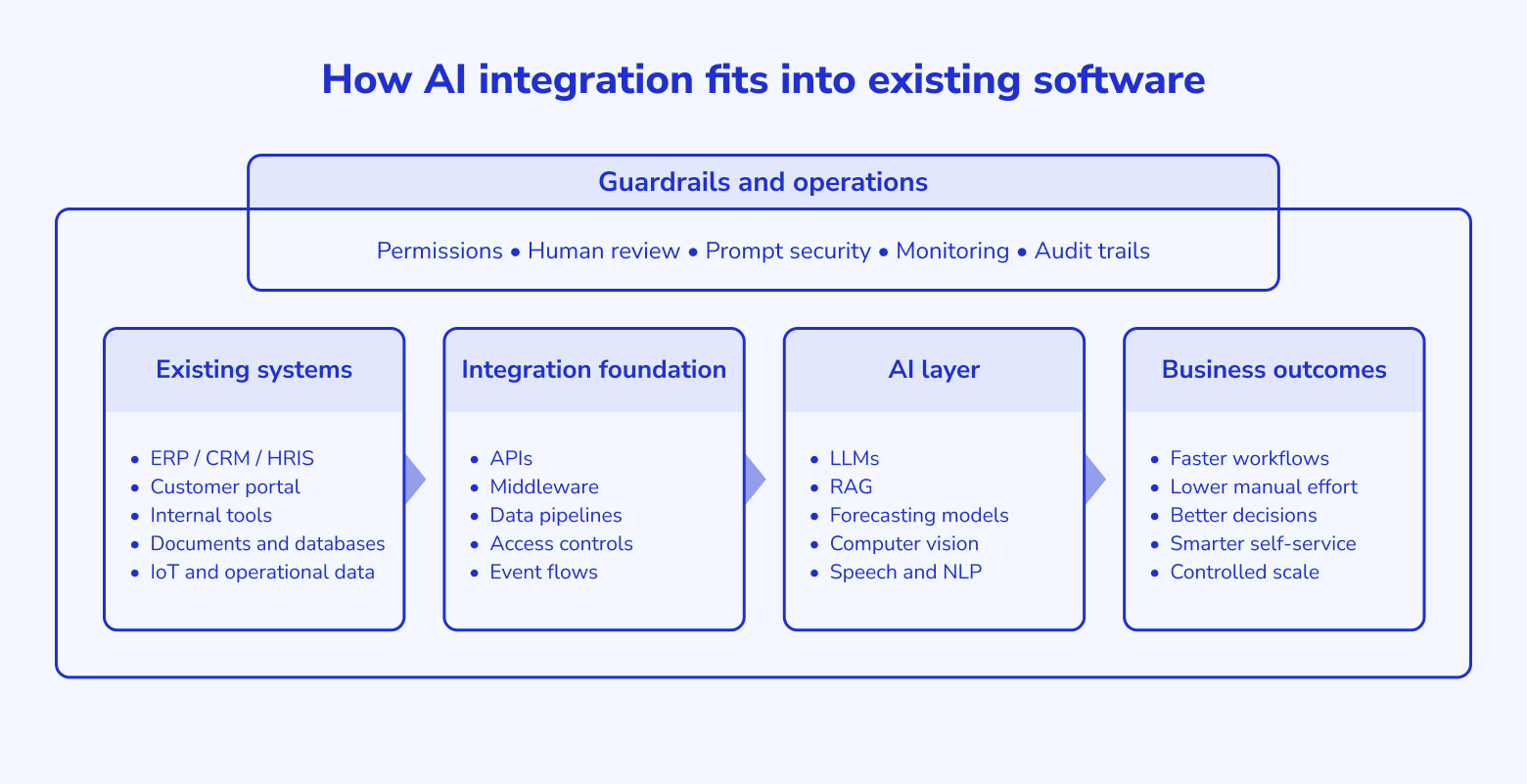
Most companies need generative AI integration services that fit their existing systems, data management, and access practices. Our AI integration consulting services focus on the implementation layer: APIs, permissions, workflows, model orchestration, and the business logic that supports them.

Legacy system augmentation
We integrate copilots and task-specific AI features into ERP, CRM, HRIS, and other internal systems. That can include assisted data entry, report drafting, record lookup, workflow guidance, and natural-language access to legacy databases through a controlled application layer.

Intelligent customer portals
We integrate AI-powered search, guided self-service, dynamic content adaptation, and autonomous level-one support flows with web and mobile apps to improve user operations inside your products.

Predictive analytics and forecasting enablement
We integrate forecasting models into the business systems teams use for planning, inventory control, maintenance scheduling, risk monitoring, and demand analysis. Forecasts appear in the tools that teams already use, rather than in a separate data science environment.

AI for operational automation
We support anomaly detection, exception alerts, process optimization, and automated responses across day-to-day operations by connecting AI models to the business systems and data pipelines you already run, from ERP and CRM to analytics platforms.

Computer vision and image recognition integration
We embed vision models into platforms and systems that rely on image classification, object detection, document capture, or visual verification.

Natural language processing and speech recognition
We integrate NLP and speech components into customer service flows, internal knowledge systems, voice interfaces, and document-heavy operations that depend on transcription, intent detection, entity extraction, or text classification.
Book your free AI strategy call
Not sure where to start? Chat with our lead architects to find the high-impact AI wins for your business.
Who we build AI solutions for
Our AI integration approach depends on company size, system complexity, and rollout scope.
Enterprises
Enterprises usually work within tighter constraints: legacy architecture, fragmented data, stricter access rules, and higher operational risk. We design generative AI integration services for that environment. That can include API modernization, controlled model access, role-based retrieval, audit trails, and staged rollout across business units. The goal is to introduce AI where it supports the business while keeping security, reliability, and system behavior under control.
One approach for software modernization and AI integration
At Nexterse LLC, AI integration starts with the system it has to work inside. We review the application logic, data flows, APIs, access rules, and performance requirements, then strengthen the foundation where needed before adding the AI layer. This helps us adapt the solution to different project types and integrate AI in a way that aligns with the software, workflow, and the level of control the business needs.
Stage 1. We prepare the system for integration
We start with the connection layer by reviewing how the system exposes data, handles service calls, and supports integration. Where needed, we strengthen APIs, middleware, event flows, and data contracts to provide the AI layer with a stable foundation.
Stage 2. We design AI as part of the application
We integrate AI into the application itself, including model calls, fallback logic, latency handling, access rules, and human review points. This helps ensure the feature aligns with the product's existing behavior and operating requirements.
Stage 3. We run software delivery and AI delivery together
Our software development lifecycle covers the deterministic parts of the system, including backend services, interfaces, infrastructure, and testing. In parallel, our agentic development lifecycle covers prompt design, retrieval behavior, tool use, and safety controls. Running both tracks together helps the integration hold up in production.
Stage 4. We build the full integration path
We design the data path, permission model, orchestration layer, and application behavior as one system. This allows the AI feature to operate within the business workflow, with the right controls and context from the start.
Get your integration quote
Ready to build? Give us a few details about your project and receive a transparent, tiered pricing proposal.
Our ADLC integration methodology
AI integration depends on the parts around the model: APIs, data access, application logic, and control points. Our delivery approach combines software modernization with AI evaluation, so the integration fits the system and can be rolled out with confidence.

API and data readiness audit
We review the system the AI will connect to, including data sources, API quality, event flows, and the access model. We also assess whether the environment can support retrieval pipelines, vector indexing, payload sizes, and the latency required by the use case. If key integration points are missing, we define what needs to be added before introducing the AI layer.

Intent and scope framing
We define what the AI can access, what it can do, which tools it can use, and where review points must stay. That includes user roles, prompt rules, retrieval sources, and fallback paths. This stage establishes the operating boundaries early, keeping the integration aligned with the workflow and risk profile.

Sandbox integration
We build the first version in a cloned or isolated environment that closely reflects the production workflow for testing. At this stage, we connect the model layer, retrieval logic, business rules, and interface components. We then assess output quality, latency, failure patterns, and cost before wider rollout.

Red-teaming, hardening, and release planning
Before release, we test the integration against prompt injection, access boundary issues, data leakage risks, and workflow edge cases. We then refine prompts, filters, orchestration rules, and review logic. This phase ends with a release plan that defines guardrails, monitoring, and the path to production.
Business benefits of AI integration

Faster operational flow

Better predictive insight

Lower manual effort at scale

Fewer avoidable errors

More personalized user experience

Stronger use of existing systems

Scalable growth with tighter control

Better return on investment
Awards& Recognitions
Nexterse LLC has been recognized by the leading analytics agencies as the top AI integration company worldwide. Our values and expertise help us provide professional AI integration services.
Our recent AI cases

A Modern Web Platform Built for Performance & Growth
We partnered with WorkHive to build a modern, responsive web experience focused on usability, performance, and scalability for long-term growth.

Transforming Business Operations with CRM & Automation
We helped Lifty streamline operations through CRM customization and intelligent automation, connecting processes and reducing repetitive work.

Building a Custom Software Platform for Insurance Operations
We developed a custom software platform tailored to the insurance business, bringing essential processes into one centralized system for teams.

Building a Smarter Digital Experience for Travel & Tourism
We helped A to Z Travel and Tours strengthen its digital presence with a modern solution that simplifies interactions and showcases travel services.

Our AI headshot platform was growing fast, and our generation pipeline was starting to show it, with turnaround times creeping up whenever demand spiked and quality consistency becoming harder to guarantee at volume. Nexterse LLC rebuilt our image pipeline around a more resilient queuing and processing architecture, so thousands of concurrent headshot jobs no longer competed for the same resources. They also tightened how we handle and discard uploaded photos, which mattered a lot given how sensitive that data is. Turnaround time dropped, output stayed consistent even during our biggest traffic days, and we've been able to scale well past a million headshots delivered without the platform buckling.

As we grew from one AI photography product to a small family of them, our engineering team was stretched thin trying to keep every product's infrastructure reliable at the same time. Nexterse LLC came in as an extension of our engineering team and helped us standardize the infrastructure across our products, so improvements to one no longer meant reinventing the wheel for another. Deploys became safer, incident response got faster, and our small team could finally focus on product instead of firefighting. It's the kind of partner that actually understands what it means to build fast without breaking things.

Our skills intelligence platform runs on a stack of proprietary language models, and as enterprise customers scaled up their usage, keeping inference fast and accurate across every model became a serious infrastructure challenge. Nexterse LLC helped us optimize how our models are served and monitored in production, cutting inference latency significantly while keeping accuracy where our enterprise customers need it. That work gave us the headroom to keep growing without our infrastructure becoming the bottleneck, and it's held up well through some of our fastest growth to date.

We set out to build a QA platform that could learn how real users move through a product and keep testing those flows on its own, but getting that kind of autonomous testing to be reliable enough for teams to actually trust was the hard part. Nexterse LLC worked with us on the engine that captures and replays user flows, helping us cut down on flaky test runs and false failures that would have killed trust in the product early on. The platform now catches real regressions before they reach users, consistently, which is the entire point of what we set out to build.

Our research produces genuinely more efficient language models, but turning that research into a product that customers could actually integrate and rely on was a different kind of problem than the one we're used to solving. Nexterse LLC helped us build the serving and integration layer around our models, so customers get a stable API and predictable performance instead of having to understand the research underneath it. That layer has made it far easier for us to get our efficiency gains in front of customers without asking them to compromise on reliability.

Running a model agency with a roster of thousands means an enormous amount of profiles, bookings, and digital assets to keep organized, and our internal tools hadn't kept pace with how the industry was moving toward digital modeling. Nexterse LLC built us a platform to manage our models' profiles, availability, and digital assets in one place, and helped us lay the technical groundwork for offering digital twins of our models to brands. What used to be scattered across spreadsheets and inboxes is now a single system our whole team relies on daily, and it's opened doors to work we simply couldn't have taken on before.

Our revenue management platform pulls in pricing and demand data from tens of thousands of properties in near real time, and as we scaled, keeping that data pipeline fast and accurate became a real engineering challenge. Nexterse LLC helped us re-architect parts of our data ingestion layer so it could handle far higher throughput without falling behind during peak booking periods. The platform now processes rate and demand signals faster and more reliably, which directly translates into better pricing recommendations for the properties that depend on us. It's exactly the kind of partner you want when the data never stops coming.
Technologies we work with




















Start with a scoped AI pilot
As the first step, most companies need one defined use case tied to a costly bottleneck. Our AI pilot-and-prove engagement is built for that stage. We identify a workflow in your current software, integrate a focused AI capability, and assess whether it is worth wider rollout.
What the pilot includes:
One defined use case
We select a workflow with explicit boundaries and a measurable downside in its current form. Common starting points include document review, internal search, support triage, and forecasting support.
A working integration
We connect the AI layer to the system, data source, or workflow it needs to support. The result is a functioning pilot built around your environment and constraints.
Cost and risk visibility
We estimate token usage, infrastructure impact, review requirements, and likely operating costs before you scale. We also identify the main technical and governance risks early.
A scale path
If the pilot performs well, you leave with a plan for the next stage. That includes architecture updates, rollout priorities, control requirements, and the steps needed to extend the use case.

Why companies choose Nexterse LLC for AI integration services
Nexterse LLC brings software engineering and AI delivery into one engagement, making your path from pilot to production consistent.

We work with the system you already have
We integrate AI into existing software, including legacy and fragmented environments. That may involve API modernization, middleware, and data-flow redesign to ensure the AI layer operates reliably.

We build for production use
We design AI features as part of the application they live in. That includes latency handling, access control, fallback logic, and review points. The integration is built for rollout and ongoing operation.

We stay model-agnostic
We choose the model and deployment approach around your environment. The decision depends on security requirements, cost limits, and the control your team needs after launch.

We tie delivery to a defined use case
We connect AI to a workflow or product function that can be assessed against a concrete outcome. That may be time saved, lower manual effort, support deflection, or stronger output quality.
Frequently asked questions
This is the integration of AI into a company's existing software, data, and workflows. This could include generative AI features in a product, automated individual tasks, predictive models, or AI-powered search of internal content with access controls.
Let's start