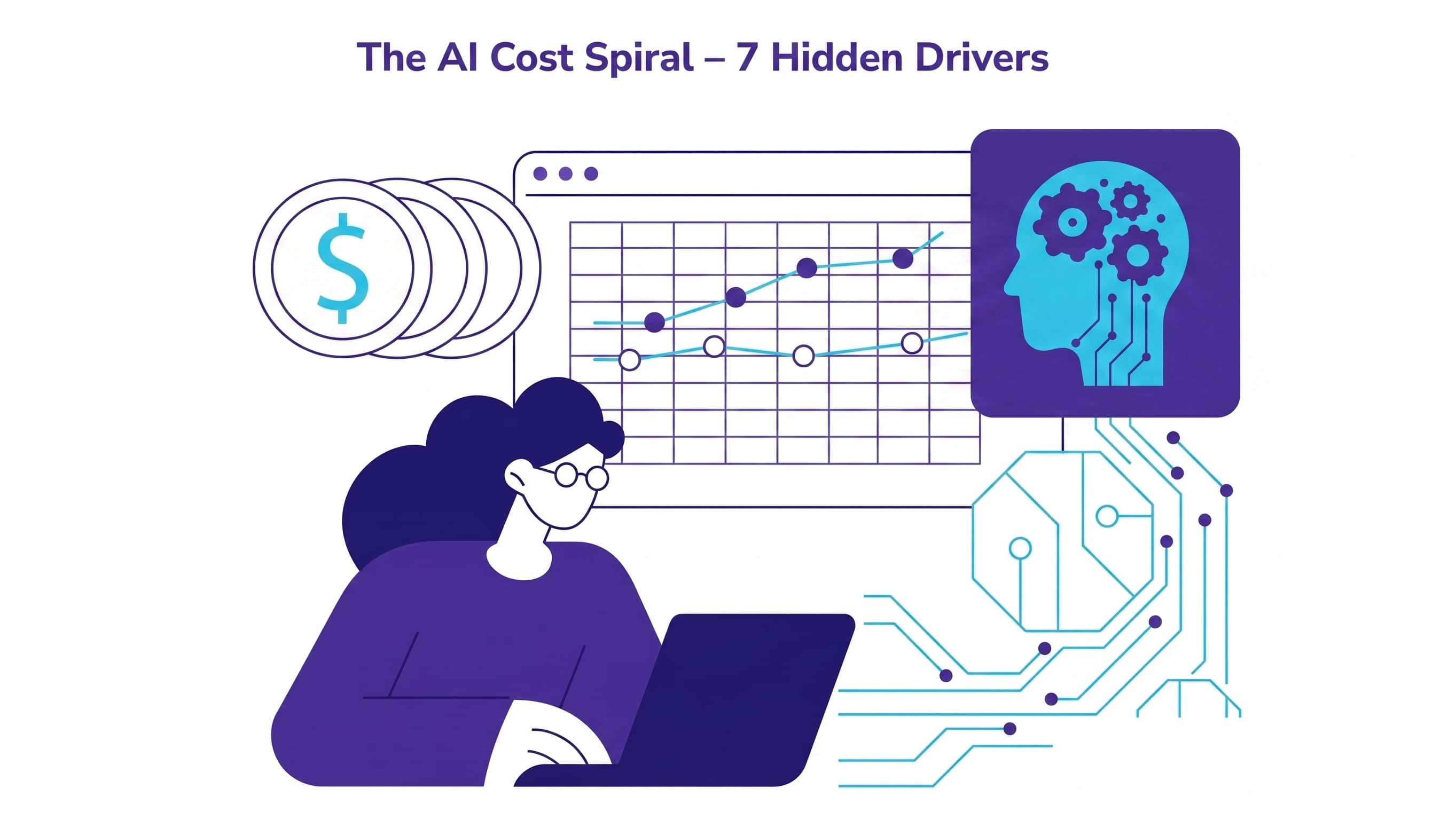











AI hype is expensive. We engineered a safer way.
80% of enterprise AI projects never reach production, and we know where they stall. A team throws together a quick prototype, stakeholders get interested, and then the friction starts. Security teams question the data flow. Finance teams ask what token usage, infrastructure, and monitoring will cost at scale. Delivery teams discover the “quick PoC” was built with shortcuts that have no place in a production path.
We don’t treat an AI proof of concept as a vague discovery phase followed by a loose prototype. We run it within our Agentic Development Lifecycle (ADLC), a delivery model where AI works within defined boundaries from day one.
ADLC is built around six ideas.
- AI is an operational component.
- Development is policy-driven.
- Quality gates are built in.
- Automation follows guardrails with explicit decision rules.
- Token costs and delivery telemetry stay observable.
- Workflows are human-led but AI-executed.
Together these strengthen the traditional software lifecycle (SDLC) by improving throughput, visibility, and control.

What happens inside the 4-week ADLC sprint
The sprint is transparent by design. Every week has its own purpose, its own outputs, and a clear part to play in reducing uncertainty. Agents run the delivery, inside a controlled framework.
Week 1: Hypothesis, scope, and guardrails
We define the business problem, the success metric, and the boundaries. This week
- We agree on one measurable business outcome.
- We define what the PoC will and will not do.
- We identify data sources and access constraints.
- We set handling rules for sensitive information.
- We outline failure conditions and refusal rules.
- We also establish the review path for stakeholders.
Week 2: Data mapping and architecture design
We map your data environment onto the solution path. This week
- We review source systems, documents, and data quality.
- We identify what we can use now and what needs cleanup.
- We select the model access path that fits your use case and governance needs.
- We define the retrieval, context, and access strategies.
- We design the deployment path for a private or tightly controlled environment.
Week 3: Engineering the sandbox
We build the proof of concept in a controlled environment, using human-led, AI-executed workflows. This week
- We set up the agent-driven workflow.
- We handle core orchestration for retrieval, reasoning, and tool use.
- We build structured task chains for the scoped use case.
- We add response controls and policy gates.
- We handle memory and state where needed.
- We add an interface layer for stakeholder review.
Week 4: Red-teaming, evaluation, and ROI readout
We stress-test the solution before you make a decision. This week
- We test against unsafe outputs, weak retrieval, and broken logic paths.
- We pressure-test prompt handling and output controls.
- We review edge cases and governance gaps.
- We finalize the runtime cost model.
- We present the PoC, the architecture blueprint, and the production roadmap.
Book your free AI discovery call
Discuss your business challenge with our AI experts and find out exactly how a PoC can solve it.
Build vs. Buy vs. Nexterse LLC
When a client says “we need full AI software development services,” there are usually four paths on the table. You can buy an off-the-shelf AI tool, ask an agency for a quick pilot, run a controlled proof of concept built for a real production decision, or take an AI readiness assessment first. If you need evidence for a go/no-go decision, those options narrow fast.
| Feature | Off-the-shelf AI SaaS | Typical agency “Free PoC” | Nexterse LLC Pilot & Prove |
|---|---|---|---|
| Data privacy | Shared vendor environment and limited control over data boundaries | Often built on public APIs with loose handling of company data | Private deployment design with controlled access and enterprise-grade boundaries |
| Customization | Limited to vendor workflows and roadmap | Thin wrapper around an API | Custom agentic architecture aligned to your use case and systems. |
| Financial predictability | Per-seat or bundled pricing hides scaling costs. | No clear usage model for token, retrieval, and infra costs. | Cost-per-query model and runtime cost projection based on agreed assumptions. |
| IP ownership | You do not own the product. | Ownership terms are often unclear. | You own the code, prompts, architecture, and delivered assets. |
What AI PoCs has Nexterse LLC delivered?

A Modern Web Platform Built for Performance & Growth
We partnered with WorkHive to build a modern, responsive web experience focused on usability, performance, and scalability for long-term growth.

Transforming Business Operations with CRM & Automation
We helped Lifty streamline operations through CRM customization and intelligent automation, connecting processes and reducing repetitive work.

Building a Custom Software Platform for Insurance Operations
We developed a custom software platform tailored to the insurance business, bringing essential processes into one centralized system for teams.

Building a Smarter Digital Experience for Travel & Tourism
We helped A to Z Travel and Tours strengthen its digital presence with a modern solution that simplifies interactions and showcases travel services.

Our AI headshot platform was growing fast, and our generation pipeline was starting to show it, with turnaround times creeping up whenever demand spiked and quality consistency becoming harder to guarantee at volume. Nexterse LLC rebuilt our image pipeline around a more resilient queuing and processing architecture, so thousands of concurrent headshot jobs no longer competed for the same resources. They also tightened how we handle and discard uploaded photos, which mattered a lot given how sensitive that data is. Turnaround time dropped, output stayed consistent even during our biggest traffic days, and we've been able to scale well past a million headshots delivered without the platform buckling.

As we grew from one AI photography product to a small family of them, our engineering team was stretched thin trying to keep every product's infrastructure reliable at the same time. Nexterse LLC came in as an extension of our engineering team and helped us standardize the infrastructure across our products, so improvements to one no longer meant reinventing the wheel for another. Deploys became safer, incident response got faster, and our small team could finally focus on product instead of firefighting. It's the kind of partner that actually understands what it means to build fast without breaking things.
Our skills intelligence platform runs on a stack of proprietary language models, and as enterprise customers scaled up their usage, keeping inference fast and accurate across every model became a serious infrastructure challenge. Nexterse LLC helped us optimize how our models are served and monitored in production, cutting inference latency significantly while keeping accuracy where our enterprise customers need it. That work gave us the headroom to keep growing without our infrastructure becoming the bottleneck, and it's held up well through some of our fastest growth to date.

We set out to build a QA platform that could learn how real users move through a product and keep testing those flows on its own, but getting that kind of autonomous testing to be reliable enough for teams to actually trust was the hard part. Nexterse LLC worked with us on the engine that captures and replays user flows, helping us cut down on flaky test runs and false failures that would have killed trust in the product early on. The platform now catches real regressions before they reach users, consistently, which is the entire point of what we set out to build.

Our research produces genuinely more efficient language models, but turning that research into a product that customers could actually integrate and rely on was a different kind of problem than the one we're used to solving. Nexterse LLC helped us build the serving and integration layer around our models, so customers get a stable API and predictable performance instead of having to understand the research underneath it. That layer has made it far easier for us to get our efficiency gains in front of customers without asking them to compromise on reliability.

Running a model agency with a roster of thousands means an enormous amount of profiles, bookings, and digital assets to keep organized, and our internal tools hadn't kept pace with how the industry was moving toward digital modeling. Nexterse LLC built us a platform to manage our models' profiles, availability, and digital assets in one place, and helped us lay the technical groundwork for offering digital twins of our models to brands. What used to be scattered across spreadsheets and inboxes is now a single system our whole team relies on daily, and it's opened doors to work we simply couldn't have taken on before.

Our revenue management platform pulls in pricing and demand data from tens of thousands of properties in near real time, and as we scaled, keeping that data pipeline fast and accurate became a real engineering challenge. Nexterse LLC helped us re-architect parts of our data ingestion layer so it could handle far higher throughput without falling behind during peak booking periods. The platform now processes rate and demand signals faster and more reliably, which directly translates into better pricing recommendations for the properties that depend on us. It's exactly the kind of partner you want when the data never stops coming.
Awards& Recognitions
What do you get from the AI PoC?
Most AI PoC services stop at “you get a prototype,” which is not enough for a serious buying decision. Nexterse LLC’s AI Pilot & Prove program delivers a full decision package instead. You get a working sandbox build, a cost model you can budget against, a security blueprint your team can review, and a clear plan for the next build.
Functional sandbox prototype
A working prototype built around one tightly scoped use case. We build it on a controlled slice of your data, or on a sanitized dataset, to find out whether the use case works in your environment and under your constraints. Typical formats include:
- RAG knowledge bot for internal search and Q&A
- Agent workflow for multi-step tasks with controlled tool access
- Document intake flow for extraction, validation, and routing
- Hybrid system combining ML models with LLM components
Your data is your IP. It stays that way.
Nexterse LLC’s AI PoC model is built on security-by-design AI. In practice, that means we use controlled access patterns and design the solution to be auditable from the start. Nexterse LLC is ISO 27001 certified and works in line with regulations, including GDPR and the EU AI Act.

Zero public training
We never treat your proprietary documents and internal data as training fuel for public models. We design the solution path around enterprise-safe model access and controlled data handling.

Guardrails before autonomy
We never hand decision-making to an unconstrained workflow. High-risk actions only run after review steps, approval logic, or hard stop conditions.

Controlled tool access
If a system can call an external service, retrieve data, or trigger an internal action, those limits are built into its design, not added afterward.

Traceability and auditability
You should be able to review the inputs, the retrieval paths, the outputs, and the execution decisions. When the system makes a weak recommendation, you need a clear way to see why.

Budget-constrained AI workflows
We never let the system run as an open meter. Cost visibility and usage limits are part of how we govern delivery.

You own the output
The code, the prompts, the architecture, and the delivered assets all belong to your company under the project agreement.
Build your AI PoC in 4 weeks
Accelerate your innovation. Let our team turn your concept into a working model quickly and cost-effectively.
Why Nexterse ADLC?
We don’t treat an AI proof of concept as a vague discovery phase followed by a loose prototype. We run it inside our Agentic Development Lifecycle (ADLC), a delivery model where AI works within defined boundaries from day one. ADLC is built around six ideas.

AI is an operational component.

Development is policy-driven.

Quality gates are built in.

Automation follows guardrails with explicit decision rules.

Token costs and delivery telemetry stay observable.

Workflows are human-led but AI-executed.
What’s in the AI PoC tech stack?
We pick tools based on your use case, how sensitive your data is, the performance you expect, and where the solution needs to run.
Foundational models and access paths
- Azure OpenAI
- AWS Bedrock
- Anthropic
- Meta Llama
- and more
Orchestration and agent frameworks
- LangChain
- AutoGen
- LlamaIndex
- CrewAI
- and more
Vector databases and retrieval
- Pinecone
- Weaviate
- pgvector
- Qdrant
- and more
Evaluation, guardrails, and observability
- Response evaluation frameworks
- Logging and traceability layers
- Access control and policy enforcement
- Usage monitoring and budget tracking










More about Nexterse LLC
Frequently asked questions
When the idea is promising but unproven, building it blind would be expensive. A PoC makes sense when you’re unsure the model will hit the accuracy you need. It also helps when leadership wants evidence before funding a full build, or when a vendor’s demo looks great but you don’t know if it holds up on your data. If the approach is already proven for your use case, you can often skip the PoC and go straight to a pilot. We’ll tell you which situation you’re in.
Let's start