The AI Cost Reduction Playbook – 9 Mechanisms, 7 Hidden Drivers, and Real-World Case Studies (2026 Edition)
Why AI budgets blow up
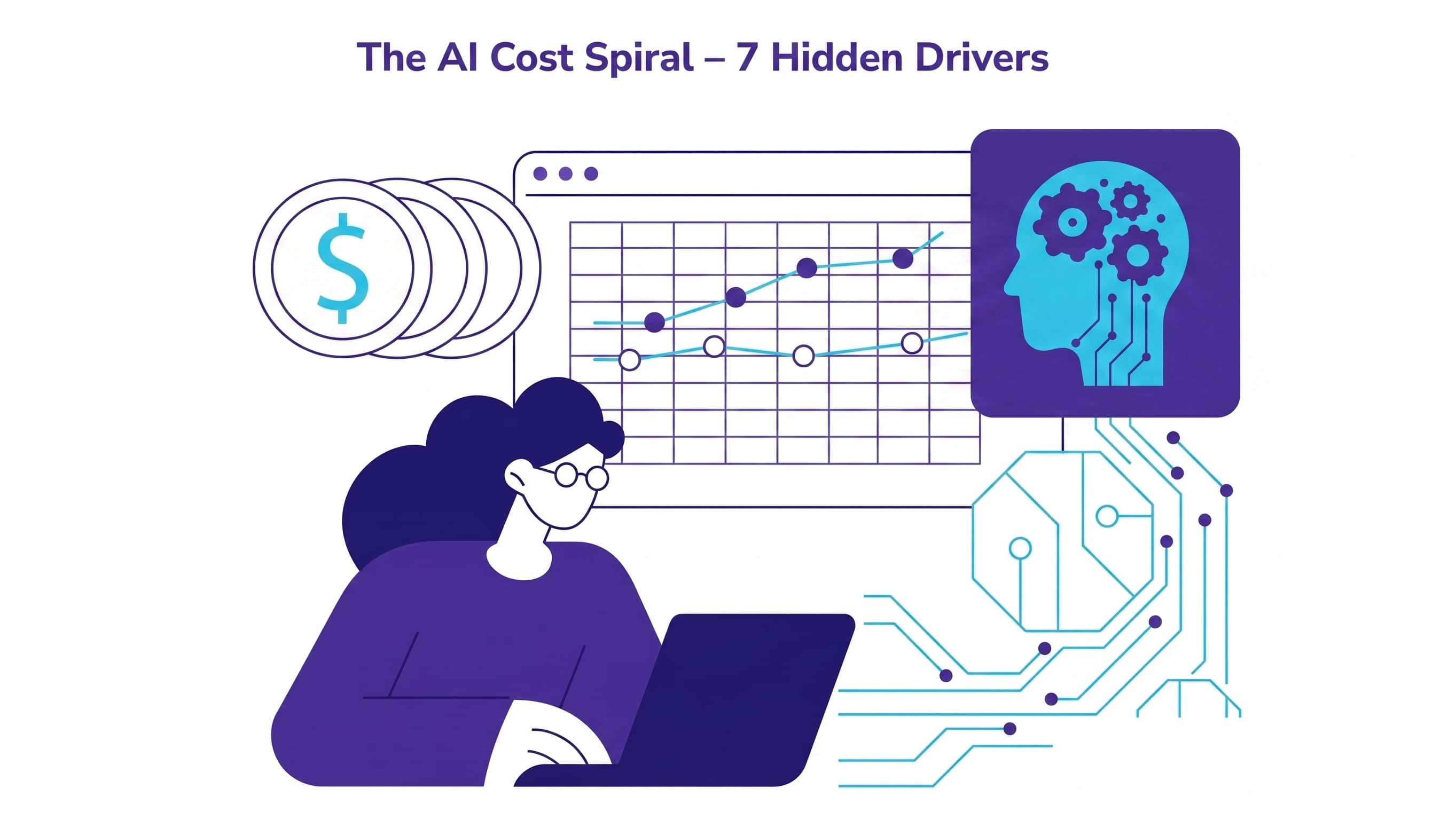
Most AI cost overruns are not caused by one bad decision. They're caused by nobody owning the number. A review of enterprise agentic AI projects found 73% run over budget, some by a factor of 2.4×, with unplanned spend averaging roughly $2.3 million per affected project. Analyst forecasts put global AI spending above $2.59 trillion in 2026, and infrastructure alone is projected to add another $401 billion in new spend this year. At that scale, a cost model built on guesswork stops being a rounding error and starts being a board-level problem.
Token consumption is not a fixed unit cost the way compute hours are. It depends on prompt length, how much context gets retrieved, and how much the model chooses to reason before answering — and agentic workloads consume tokens recursively, so one user action can trigger dozens of model calls before it produces a visible result.
That's the core problem this playbook addresses: most teams price an AI feature once, at demo time, on a small dataset, and then never revisit the number as usage scales, as agents chain calls together, or as a model provider quietly changes pricing. The fix isn't a single optimization — it's closing seven specific gaps where cost hides, using nine concrete mechanisms, with governance that keeps the number honest after launch.
7 hidden cost drivers
- Context bloat. Retrieval pipelines that pull in more documents than the question needs, padding every call with tokens the model never uses.
- Recursive agent calls. Multi-step agents that re-plan, retry, and call tools in loops with no ceiling on how many round-trips a single task can take.
- No model tiering. Routing every request — from a simple classification to a complex reasoning task — through the same frontier model.
- Duplicate inference. The same question, or a near-identical one, re-computed from scratch instead of served from a cache.
- Untracked ownership. Dozens of teams running production AI workloads with no single owner for the combined bill, so nobody notices a cost spike until finance does.
- Provider price drift. Model pricing changes that don't get re-modeled into the product's unit economics after launch.
- No per-feature attribution. Traditional cloud cost tools can't break spend down by feature or customer, so a runaway cost center hides inside a single aggregate line.
9 mechanisms that bring cost back down
Enterprises that get AI cost under control typically combine several of the following rather than relying on one silver bullet. Reported combined savings range from 30% to 60% of AI infrastructure spend.
- Prompt compression — trimming instructions and examples to the minimum that preserves output quality.
- Model tiering — routing simple, high-volume tasks to smaller or open-weight models and reserving frontier models for genuinely hard reasoning.
- Output and embedding caching — serving repeated or near-duplicate queries from a cache instead of re-running inference.
- Retrieval scoping — tightening what a RAG pipeline pulls into context so the model reads less per call.
- Call-count ceilings — hard limits on how many tool calls or re-plans an agent can make per task before it escalates to a human.
- Batching and off-peak scheduling — grouping non-urgent inference jobs to take advantage of lower-cost windows.
- Per-feature cost attribution — tagging every call so spend can be traced to the feature and customer that generated it, not just to a single AI line item.
- Right-sized fine-tuning — fine-tuning a smaller model for a narrow, repeated task instead of prompting a large general model for it every time.
- Continuous re-pricing — re-modeling unit economics whenever provider pricing changes, not just at initial launch.
Real-world case studies
| Situation | Mechanism applied | Result |
|---|---|---|
| High-volume customer support triage | Model tiering + caching | Majority of tickets routed to a smaller model; frontier model reserved for escalations |
| RAG copilot over internal documents | Retrieval scoping + prompt compression | Meaningful reduction in tokens per query without a measurable drop in answer quality |
| Multi-step research agent | Call-count ceilings | Runaway multi-call loops capped, removing the long tail of abnormally expensive tasks |
| Multi-team AI platform | Per-feature cost attribution | First time finance could see which product feature — not just which team — drove the AI bill |
The pattern across all four: nobody added a new AI capability to fix cost. Each fix targeted a specific, named driver from the list above, and each was measurable in a normal FinOps or engineering sprint rather than a multi-quarter platform rebuild.
Building a token-cost dashboard
None of the nine mechanisms above work for long without visibility. A cost dashboard purpose-built for AI spend needs to answer a different set of questions than a standard cloud cost dashboard, because the unit of spend is a model call, not a compute-hour.
- Cost per feature, not just per environment. Group spend by the product feature that triggered it — a chat widget, a document-summary button — not just by which cluster or account it ran in.
- Cost per interaction, tracked as a distribution, not an average. A mean cost per query hides the long tail of expensive outlier calls that usually turn out to be the actual budget problem.
- Call-chain depth per task. For agentic features, track how many model calls a single task triggers — a creeping average is an early warning a ceiling needs tightening.
- Cache hit rate. A falling hit rate on repeated queries is often the first visible sign that caching logic has quietly broken after a deploy.
- Alert thresholds tied to the per-interaction ceiling, not just to a monthly total — a monthly alert fires weeks after the cause; a per-interaction alert fires the day it starts.
Common mistakes when cutting AI cost
- Optimizing the average instead of the outliers. A handful of abnormally expensive calls usually drive a disproportionate share of the bill — fix those first, not the typical-case call that was already cheap.
- Downgrading models without measuring quality impact. A cheaper model can quietly increase support escalations or rework elsewhere, which erases the savings it appeared to create.
- Treating cost cutting as a one-time project. Usage patterns and provider pricing both drift; a cost model that isn't re-checked degrades within a quarter or two.
- Capping call chains without a fallback path. A hard ceiling that just fails a task outright, instead of escalating it to a human, trades a cost problem for a reliability one.
Building the cost-governance discipline
Cost control that survives beyond the first optimization pass is a discipline, not a one-time cleanup. Under our Agentic Development Lifecycle, we forecast projected token consumption and infrastructure cost during discovery — before a line of code ships — and carry per-interaction cost ceilings, alerting, and periodic re-pricing into production. Treating cost as an engineering requirement from day one is what keeps a 2026 launch from becoming a 2027 budget surprise.
Frequently asked questions
Why do AI projects go over budget more often than traditional software projects?
Traditional infrastructure cost is largely fixed once provisioned. AI inference cost scales with usage in ways that are hard to predict up front — prompt length, retrieval volume, and agentic call chains all move the number after launch, and most teams price the feature once at demo time and never revisit it.
What's the fastest cost win to implement first?
Model tiering and output caching usually deliver the fastest measurable reduction, because they don't require re-architecting a pipeline — just routing logic and a cache layer in front of calls that are already being made.
Does reducing AI cost hurt output quality?
Not when it's done by removing waste rather than removing capability. Prompt compression and retrieval scoping target tokens the model wasn't using productively in the first place; the mechanisms that do carry a quality trade-off, like aggressive model downgrades, should be tested against real outputs before rolling out broadly.
How do we know which feature is actually driving our AI bill?
Per-feature cost attribution — tagging every inference call with the feature and customer that triggered it — is the mechanism most enterprises are missing. Without it, AI spend shows up as one opaque line item, and a single runaway feature can hide inside an otherwise reasonable-looking aggregate.
Summary
AI cost overruns are rarely one bad decision — they're an unowned number that compounds across seven specific gaps: context bloat, recursive agent calls, no model tiering, duplicate inference, untracked ownership, provider price drift, and missing per-feature attribution. Closing them doesn't require a platform rebuild — prompt compression, model tiering, caching, retrieval scoping, call-count ceilings, batching, cost attribution, right-sized fine-tuning, and continuous re-pricing are concrete, measurable mechanisms enterprises are already combining to cut AI spend 30–60%. The teams that keep costs under control long-term treat this as an engineering discipline built in from day one, not a cleanup pass after finance flags the bill.