From Pilot to Production: Why Enterprise AI Stalls. The Framework to Scale It (2026)
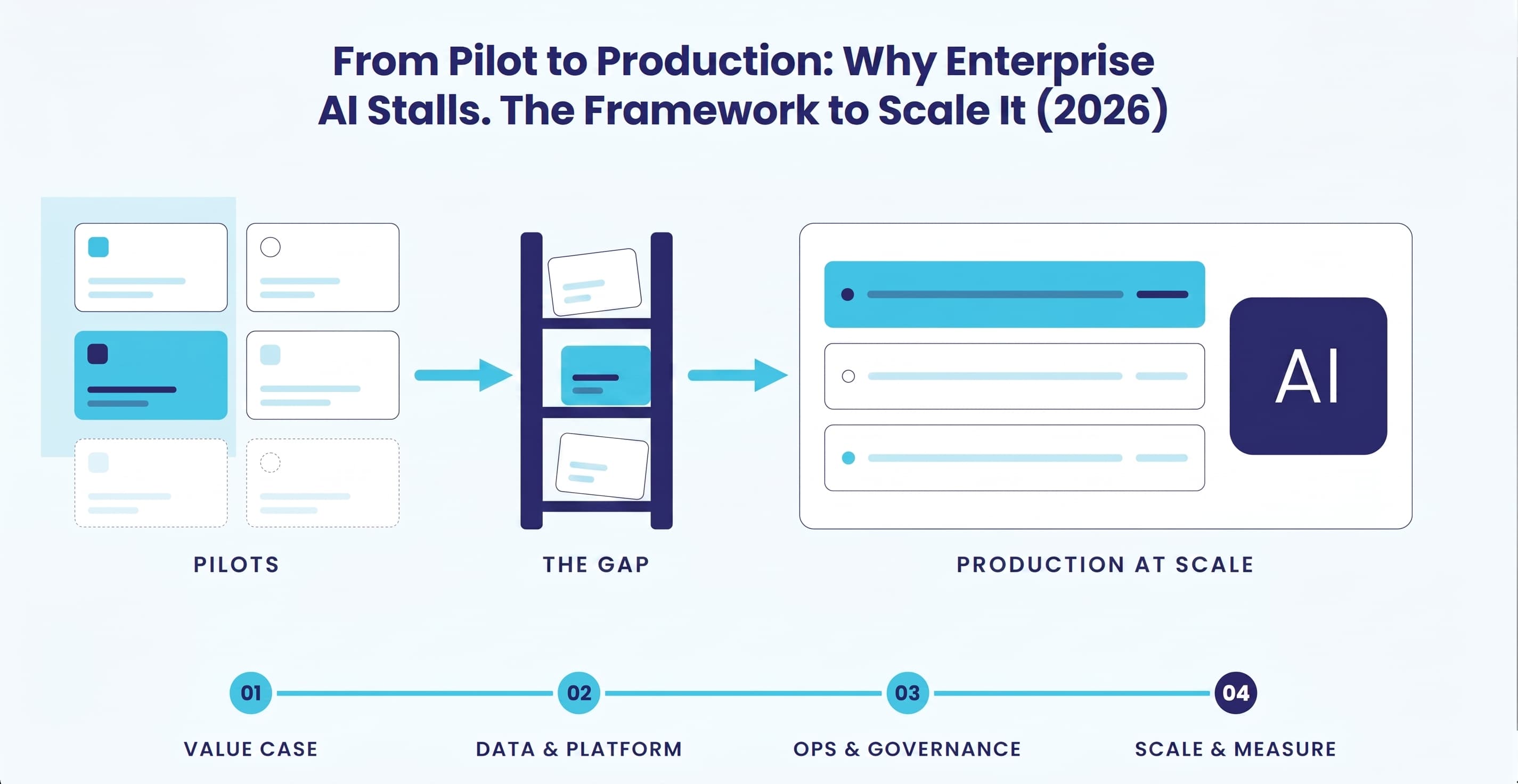
The 88% that never ship
The most-repeated number in enterprise AI right now is that 88% of AI agent pilots never reach production. It's been reported by multiple independent research groups, which makes it hard to dismiss as one bad survey. The more useful number sits underneath it: 78% of Global 2000 companies now report at least one AI workload in production, up from 41% two years ago — so the technology clearly can ship. Most individual pilots inside those same companies still don't.
Median time from pilot to production has fallen from 11 months to about 4.2 months for the pilots that do make it. That's the gap this framework is about: not "can AI work," which is already answered, but why a specific pilot — one with a working demo and a supportive sponsor — still stalls before it reaches a production system real users depend on.
What the 12% that scale have in common
The pilots that make it to production share an unusually consistent operating profile, regardless of industry or use case:
- Named ownership. One person is accountable for the pilot's outcome after launch, not just for building it.
- Scoped success criteria, set before the pilot started. Not "see if this is useful" — a specific, pre-agreed metric the pilot has to hit.
- Automated evaluation. A repeatable way to measure output quality that doesn't depend on someone manually reviewing transcripts.
- Organizational tolerance for rollback. The ability to ship, measure, and roll back without the rollback being read as institutional failure.
Projects with clear, pre-approved success metrics reach a 54% success rate — more than four times the baseline. The pattern isn't about model choice or engineering talent. It's about whether the organization set itself up to make a clear go/no-go decision at all.
The pilot-to-production ladder
- Hypothesis and guardrails. Define the ROI target, the token budget, and the operational boundaries before writing the first prompt.
- Scoped proof of value. Run the pilot against a controlled slice of real data, with the success metric from step 1 measured automatically, not eyeballed.
- Red-team before scale. Adversarial testing — prompt injection, edge cases, failure modes — happens before the pilot touches more users, not after.
- Phased rollout with a rollback path. Production access expands in stages, each with a tested way to revert if the metric regresses.
- Named operational ownership. The pilot's sponsor and its production owner are named and may not be the same person — but both exist before go-live.
Where teams accidentally restart from zero
The most expensive failure mode isn't a pilot that never gets funded — it's a pilot that gets re-approved every quarter under a new name because nobody set a measurable stopping condition the first time. Three patterns cause this most often:
- No pre-agreed success metric, so "is this working" becomes a subjective, recurring debate instead of a one-time decision.
- Evaluation that requires manual review, which doesn't scale past the pilot phase and quietly stops happening once the novelty wears off.
- Ownership that lived with the pilot's champion, who moves teams or roles, and the pilot loses its only accountable owner.
Who should own the go/no-go decision
Named ownership only works if it sits with someone who can actually make the call. The pattern that holds up across most successful scale-ups: the pilot's business sponsor owns the success metric and the go/no-go decision, while a separate technical owner is accountable for the evaluation pipeline and rollback readiness that decision depends on. Splitting the two roles matters — a sponsor too close to the pilot's outcome has an incentive to interpret ambiguous results generously, and a technical owner without decision authority can't act on a red flag they see.
Both roles need to survive personnel changes. Documenting the metric, the evaluation method, and the rollback plan in a place the whole team can see — not just in the sponsor's head — is what keeps a pilot alive when its original champion moves to a different role, which is one of the three most common ways a pilot silently restarts from zero.
Early signs a pilot is ready to scale
- The evaluation metric has stopped moving for several consecutive measurement cycles, in a good way — stability, not a single lucky spike, is the signal worth acting on.
- The team can explain a failure case without opening a transcript. If the automated evaluation pipeline already categorizes why a given interaction failed, it's mature enough to run unattended at higher volume.
- Rollback has been exercised at least once, deliberately, during the pilot — not just planned for. A rollback path that's never been tested is a rollback path that's untested when it matters.
- The cost-per-interaction number is known and stable, not still being estimated — scaling multiplies whatever the current unit economics are, good or bad.
Scaling without restarting
Scaling a pilot successfully is less about the model and more about whether the organization did the unglamorous work up front: a metric everyone agreed to before they saw the results, an evaluation pipeline that runs without a human in the loop, and a named owner who outlasts the original champion. Under our Agentic Development Lifecycle, those three things are gates a pilot has to clear before it's allowed to request production budget — which is exactly the operating profile the 12% that scale already share, made structural instead of optional.
Frequently asked questions
Why do most AI agent pilots fail to reach production?
Not because the technology doesn't work — 78% of large enterprises already have some AI workload in production. Individual pilots stall most often because success wasn't defined measurably before the pilot started, so there's no clear moment to decide it's ready to scale, or to decide it isn't and move on.
How long should a pilot-to-production timeline realistically take?
Median time has fallen to about 4.2 months for pilots that do reach production, down from 11 months two years ago. Timelines that stretch well beyond that are usually a sign the success criteria weren't scoped tightly enough at the start, not that the technology needs more time.
What's the single highest-leverage change a stalled pilot can make?
Write down a specific, measurable success metric retroactively if one doesn't already exist, and get organizational agreement on it before the next review. Projects with pre-approved metrics succeed at roughly four times the rate of those without one — it's the single biggest lever in the data.
Does scaling a pilot mean giving it access to more data and more users at once?
No — phased rollout with a tested rollback path at each stage is what separates pilots that scale safely from ones that create an incident. Expanding access in stages, each measured against the same success metric, is what lets an organization catch a regression before it affects everyone.
Summary
88% of AI agent pilots never reach production, even as 78% of large enterprises already run some AI workload live — the gap is organizational, not technical. The pilots that scale share a consistent profile: named ownership, success criteria agreed before the pilot started, automated (not manual) evaluation, and tolerance for rollback without treating it as failure. Projects with pre-approved metrics succeed at roughly four times the baseline rate. Most stalled pilots aren't stuck because the model underperformed — they're stuck because nobody set a measurable way to know whether to scale them or shut them down, and building that structure in from the start is what turns a promising demo into a production system.