The Advantages of Applied AI: Business Benefits in 2026
What applied AI actually is
Applied AI is the difference between a dashboard a person has to interpret and a system that reacts on its own. Traditional monitoring collects sensor data and routes it to a screen for a human to read. Applied AI combines that same operational data with embedded prediction and decision-making, so the system can flag — or act on — a developing problem before a person would have noticed it on the dashboard at all.
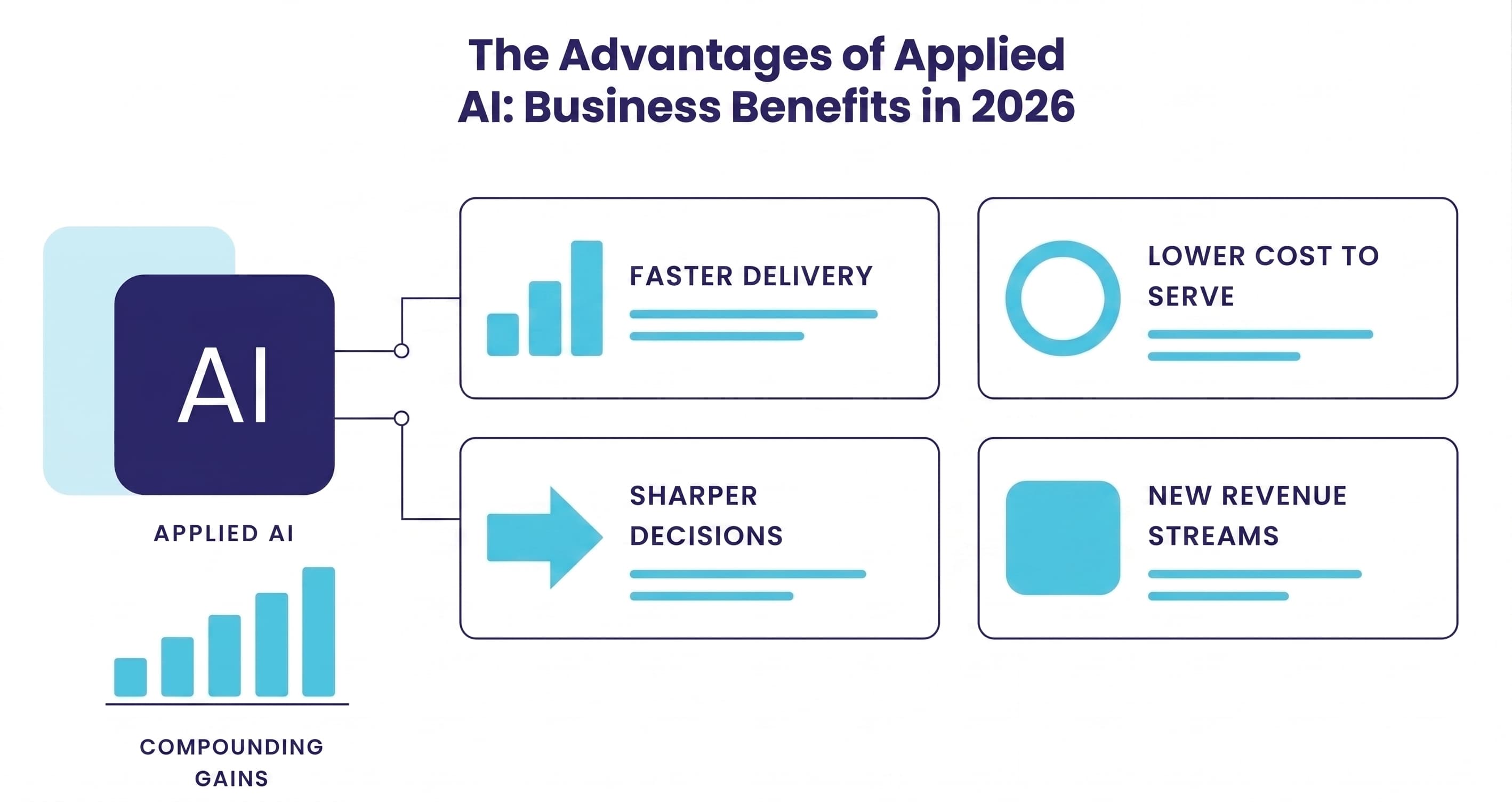
Four business benefits, with real numbers
- Reduced unplanned downtime. Predictive maintenance applications report cutting unplanned downtime by up to 50%, with typical payback windows of 9–24 months in asset-intensive operations.
- Lower maintenance cost. The same predictive approach commonly reduces total maintenance spend 10–40%, by replacing fixed maintenance schedules with condition-based intervention.
- Extended asset lifecycle. Catching wear patterns early rather than after failure has been shown to extend usable asset life by roughly 20–40% in reported deployments.
- Faster, better-informed decisions. Applied AI surfaces the handful of signals that matter out of a much larger stream of sensor noise, so the humans still in the loop are deciding on a shortlist, not scanning a raw feed.
Edge and cloud, working together
Most real deployments split the work between edge and cloud rather than choosing one. Edge AI runs close to the equipment, handling latency-sensitive inference and continuing to operate if connectivity drops. The cloud layer handles training, retraining, and fleet-wide analytics across every connected site. The right split depends on connectivity reliability and the cost math on edge hardware — it's worth validating against the specific deployment profile during discovery rather than defaulting to one architecture everywhere.
Where it fits with legacy equipment
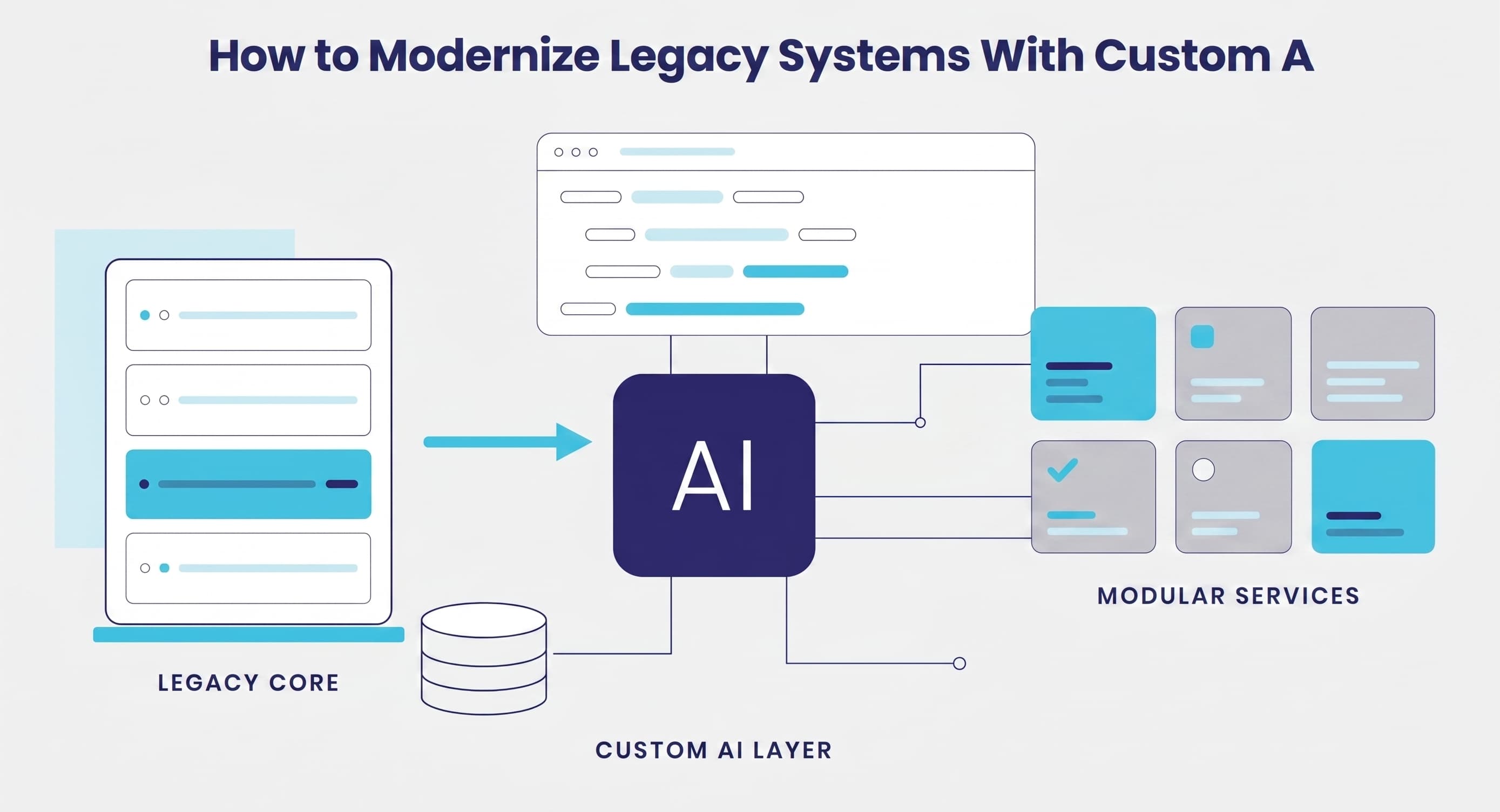
- Legacy equipment doesn't need to be replaced first. Gateway integration and protocol translation let older machines participate in monitoring and prediction without a hardware upgrade.
- Applied AI should never query a legacy transactional database directly. Heavy AI querying against a live operational system risks destabilizing it — the safer pattern syncs data to a decoupled analytics layer instead.
- High-frequency sensor data should be filtered at the edge before it reaches the cloud, not pushed upstream raw — this keeps both cloud cost and latency predictable as a deployment scales across more equipment.
Applied AI beyond manufacturing
Manufacturing produces the clearest numbers because downtime and maintenance cost are already tracked closely, but the same reacting-instead-of-reporting pattern shows up wherever continuous operational data exists:
| Sector | What the system reacts to |
|---|---|
| Logistics | Route and load conditions, adjusting plans before a delay compounds |
| Energy | Grid load and equipment condition signals across distributed assets |
| Healthcare operations | Patient-monitoring telemetry, flagging deterioration before a scheduled check |
| Retail / ecommerce | Demand and inventory signals, adjusting replenishment before a stockout |
| Financial services | Transaction pattern signals, flagging fraud in the moment rather than in a nightly batch report |
How to measure whether it's actually working
- Compare against the same baseline metric the manual process already tracked, not a new metric invented to make the AI system look good.
- Track false-positive and false-negative rates explicitly, not just the headline downtime or cost number — a system that over-alerts erodes trust just as much as one that misses real problems.
- Watch adoption, not just accuracy. A technically accurate system that operators route around because it's inconvenient delivers none of the modeled ROI.
- Re-validate the model against new equipment or seasons, since a model trained on one operating condition can quietly degrade when conditions shift.
Getting started without a full rebuild
The businesses that see the numbers above usually didn't start by instrumenting an entire facility at once. They picked one equipment class with a clear, already-tracked cost (unplanned downtime on a specific production line, for example), proved the model against it, and expanded from there. That narrow starting scope is what makes the ROI numbers measurable in the first place — and it's the same pattern that shows up across almost every successful applied AI deployment, regardless of industry.
Frequently asked questions
Is applied AI only relevant to manufacturing?
Manufacturing and industrial operations produce the clearest, most-cited numbers because downtime and maintenance cost are already tracked closely there, but the same pattern — embedding prediction into an operational process instead of leaving it to a dashboard — applies to logistics, energy, healthcare operations, and any function with continuous operational data.
Do we need to replace our existing equipment to use applied AI?
Usually not. Gateway integration and protocol translation let legacy equipment participate in monitoring and prediction without being replaced — in many deployments, the equipment stays exactly as it is, and only the data layer around it changes.
What's the typical payback period for a predictive maintenance deployment?
Reported ranges commonly fall between 9 and 24 months for asset-intensive operations, with some manufacturing deployments reporting closer to 12 months — though the actual number depends heavily on how costly the downtime being prevented already was.
Should we start with an edge deployment or a cloud deployment?
Most successful deployments use both: edge for latency-sensitive inference and offline resilience, cloud for training and fleet-wide analytics. The right split depends on connectivity reliability at your specific sites, which is worth validating before committing to an architecture.
Summary
Applied AI's core advantage over traditional monitoring is simple: it turns operational data into a system that reacts, instead of a dashboard a person has to interpret. In asset-intensive operations, that shows up as measurable numbers — up to 50% less unplanned downtime, 10–40% lower maintenance cost, and 20–40% longer asset life — typically paying back within 9 to 24 months. None of it requires replacing legacy equipment first; gateway integration lets older machines participate, and the safest architectures keep AI querying a decoupled data layer rather than a live transactional system. The deployments that reach these numbers almost always started narrow, on one equipment class with an already-tracked cost, and expanded only after the model proved itself there.