AI Readiness: How Companies Move from AI Pilots to Production in 2026 [Research]
Readiness, not ambition
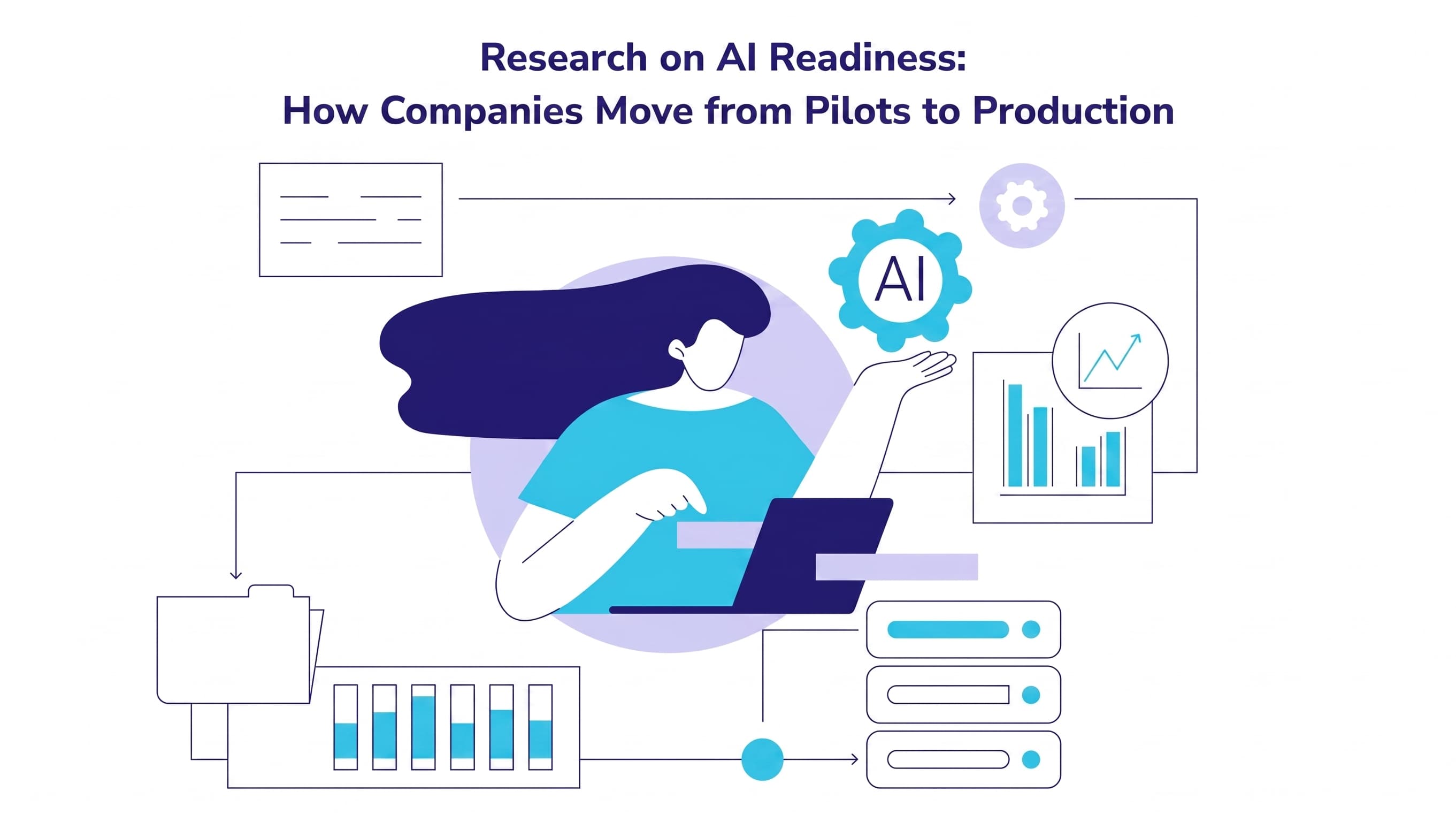
Two companies can run the same AI pilot with the same model and get different outcomes, because the model was never the variable that mattered. 41% of enterprises reach ROI within 12 months on their AI initiatives — and 19% of agentic projects never reach payback at all. The split between those two groups traces back almost entirely to readiness: whether the data, infrastructure, compliance posture, and workflow existed to support the pilot before it started, not to how ambitious the pilot's goal was.
The five dimensions of a readiness audit
Before writing any code, a proper readiness audit evaluates five dimensions — in this order, because each one gates the next:
- Data availability and quality. Is the data the AI needs centralized and clean, or fragmented across systems, unstructured, and manually maintained? This is the dimension most pilots underestimate.
- Infrastructure and integration constraints. Can the target system actually be connected to safely — does it have modern APIs, or does the pilot risk destabilizing a legacy transactional database?
- Security and compliance exposure. What regulatory framework applies — GDPR, HIPAA, the EU AI Act — and does the organization's current posture support it, or does compliance work need to happen first?
- Operational workflow impact. Does a person's actual day-to-day process change if this pilot succeeds, and has that person been part of defining what success looks like?
- Projected token consumption and cloud costs. What will this cost to run at production volume, not pilot volume — modeled before the pilot starts, not discovered after.
Matching the tier to the readiness level
Readiness findings map naturally onto four tiers of AI investment, and the audit's real job is telling a company honestly which tier it's ready for — not which tier it wants to be at:
- Tier 1 — AI readiness and consulting. The audit itself: confirming whether AI is economically justified for a specific use case before committing budget.
- Tier 2 — RAG systems and copilots. Connecting AI to internal documents and knowledge bases with citations and traceability. Where most enterprises correctly start production AI.
- Tier 3 — Agentic workflows. Multi-agent systems that retrieve data, reason over business rules, and take action — appropriate once Tier 2 has proven the underlying data and evaluation foundation works.
- Tier 4 — Custom AI models. Fine-tuned or privately hosted models for regulated or highly specialized environments — the tier requiring the deepest readiness across all five dimensions.
Companies that scale successfully almost always start at the lowest tier that can prove measurable value and move up only after that tier is working in production — not because higher tiers are riskier in the abstract, but because each tier assumes the readiness gaps below it are already closed.
What a readiness audit actually outputs
A useful readiness audit doesn't end in a slide saying "you're ready" or "you're not." It ends in a specific recommendation: build the use case as scoped, build it differently because of a constraint the audit surfaced, or don't build it yet because a deterministic solution already solves the problem faster and cheaper. That third outcome is the one most vendors are reluctant to deliver — and the one that protects the budget most reliably when it's the right call.
A quick self-assessment checklist
Before commissioning a formal audit, a team can get a rough read on its own readiness with five honest yes/no questions, one per dimension:
- Can we name the specific system of record the data would come from, or does the answer involve "a few different spreadsheets and someone's inbox"?
- Does the target system have a modern API, or would this require querying a legacy database directly?
- Do we already know which regulatory framework applies, or has that question not been asked yet?
- Has the person whose workflow changes been part of scoping this, or is this being decided entirely above their level?
- Could we say, today, roughly what this would cost to run at 10x pilot volume? A confident "no idea" is itself a useful, honest data point.
Two or more "no" answers is a reasonable signal that a formal audit — or at minimum, a scoping conversation — should happen before committing engineering time to a pilot.
How readiness gaps actually get closed
- Data gaps close fastest with a narrow, targeted cleanup of the specific dataset the pilot needs — not a company-wide data-quality initiative, which takes far longer and isn't necessary to unblock one use case.
- Infrastructure gaps are often closed by adding a decoupled read layer (a synced replica or vector index) rather than modifying the legacy system directly — faster and lower-risk than a system migration.
- Compliance gaps typically need a defined data-handling and access-control design reviewed by whoever owns regulatory sign-off, done once and reused across future AI projects in the same domain.
- Workflow gaps close through a short structured conversation with the people whose day-to-day process is changing — cheap, fast, and the step most often skipped under time pressure.
Sometimes the honest answer is not yet
The companies that move from pilot to production successfully aren't the ones with the most ambitious roadmap — they're the ones willing to hear that a specific initiative needs six more weeks of data cleanup, or a different scope, before it's worth building. Readiness work done honestly up front is what turns a pilot into a production system instead of into a case study on why the ambitious version had to be quietly shelved.
Frequently asked questions
How long does a proper AI readiness audit typically take?
A focused audit covering all five dimensions typically runs a few weeks, not months — it's meant to be fast enough to happen before committing significant engineering budget, not itself become a large project.
Which readiness dimension causes the most pilots to stall?
Data availability and quality, most often. Infrastructure and compliance gaps are usually visible early; fragmented or inconsistent data tends to surface only once a pilot is already underway, which is exactly why it needs to be assessed before the pilot starts, not during it.
Can a company be ready for Tier 2 (RAG/copilots) but not Tier 3 (agentic workflows)?
Yes, and this is the most common readiness gap in practice. Tier 3 assumes the data foundation and evaluation discipline built during Tier 2 are already solid — skipping straight to agentic workflows without that foundation is a leading cause of the projects that never reach payback.
What does it mean if a readiness audit recommends against building an AI solution?
It means a deterministic, rule-based approach solves the problem faster, cheaper, or more reliably for that specific use case — not that AI doesn't work generally. A readiness process that only ever says yes isn't actually assessing readiness; it's a sales process wearing an audit's clothing.
Summary
Whether an AI pilot reaches production tracks much more closely with organizational readiness than with model choice or engineering skill — 41% of enterprises reach ROI within a year, while 19% of agentic projects never reach payback at all, and the split traces back to data quality, infrastructure fit, compliance posture, workflow buy-in, and cost modeling done honestly before the pilot starts. Readiness maps naturally onto four investment tiers, and companies that scale successfully start at the lowest tier that proves value and move up only once that foundation is solid. The audits that actually help are the ones willing to say not yet — because that answer, delivered early, is what protects the budget for the pilot that's genuinely ready to scale.